
Teachers group files suit over charter school

The state teachers lobby filed a fraud lawsuit Friday against the creators of a planned charter school in south Alabama accusing them of misleading a state commission about their finances and level of community support. The lawsuit filed by the Washington County chapter of the Alabama Education Association seeks to block public funds from going to Woodland Preparatory school in Washington County. “The citizens of Washington County do not want this school,” AEA Associate Executive Director Theron Stokes said in a press conference. The lawsuit claims the planned charter school does not have significant support from the community, as required by law, and is a front for a private education company. A lawyer representing Woodland Prep disputed the accusations and said local supporters wanted a school choice option because of concerns about test scores at traditional public schools in the county. “While we’ve been trying to give students and parents an option for a better education, the opposition in Washington County has been led by teachers afraid of losing their jobs and union bosses who fear losing union dues,” a statement released on behalf of Woodland Prep said. The suit names Washington County Students First, the locally incorporated group, that applied to start the school, and consultant Soner Tarim and his company Unity School Services who were hired by to operate Woodland Prep. Stokes said they believe that the group who applied to open the school is a front for Tarim. “We feel like this is an attempt from someone who wants to get a payday,” Stokes said. Woodland Prep’s statement said the school’s board picked Tarim “to bring about an innovative and challenging educational opportunity” to students in Washington County. The Alabama Public Charter School Commission gave the permission to open the charter school. The approval came despite that the National Association of Charter School Authorizers found the application “does not meet the standard for approval,” according to the lawsuit. Woodland Prep was supposed to open this month but received an extension. The lawsuit also accused the school of improperly seeking students from Mississippi to attend the school that would be funded with Alabama tax dollars. Woodland Prep denied that but said it has been targeting parents from Washington County who are currently sending their children to schools in Mississippi “in hopes of a better education.” Public charter schools are schools that receive government funds but operate independently. Alabama lawmakers authorized the creation of charter schools in 2015. A few have opened but more are planned. Stokes said AEA is not opposed to all charter schools. “This is not about charter schools. This is about bad charter schools,” said Tom Loper, an attorney representing the plaintiffs in the case. Republished with permission of the Associated Press.
Cam Ward: A thank you note to Alabama’s teachers

My oldest daughter just turned sixteen. She’s driving, and as a dad, it’s a thrilling, but scary moment in life — this week, she started the tenth grade, and the reality is that during the school year, she spends nearly as much time at school as she does around her mom and me. For young people like my daughter, those hours at school are shaped primarily by their fellow students and their teachers. If everything turns out right, a young person will enter Alabama’s schools around the age of five or six, and by the time they graduate at seventeen or eighteen, they will have a solid grasp of the fundamentals of mathematics, history, American and English literature, biology, and chemistry, among other subjects. We entrust teachers with the awesome responsibility of educating our young people about the basic structure of the universe – to understand and reason through, for instance, the process of photosynthesis – so that they can think analytically when confronted with any type of problem. That’s an incredible responsibility; and to teach such important knowledge to students who, well, haven’t yet achieved full impulse control, is no small task. We trust our teachers to impart knowledge and facts, but we also expect our teachers to model virtuous behavior before our young people, because knowledge isn’t the same thing as wisdom, and we want our kids to become responsible adults. The best teachers can not only clearly communicate lessons on the history of the Civil Rights movement, but can also talk about, and model in person, the virtues of courage and perseverance that animated heroes like Rosa Parks. Facts are stubborn things, as the British Prime Minister Margaret Thatcher once said, and what she meant by that is that the world is governed by certain unalterable truths, including, for instance, the truth that a free market economy lifts more people out of poverty than socialism does. Teachers turn this knowledge into wisdom by showing students the link between effort and reward: the harder you work, the better grades you will get, and the harder you work once you graduate, the more opportunities you will have in the workplace. Great teachers impart knowledge and model wisdom, and often they do so at a great cost to themselves: growing up, the best teachers I had were the ones who were willing to stay a few minutes after class to answer my fifteenth question how to solve a quadratic equation. Many teachers often sacrifice time and effort beyond what’s required — the clock often begins before eight, rarely stops at five, and every hour in-between is dedicated to their craft. As a state senator, I am committed to ensuring that our schools are well-funded and that our teachers are competitively paid. Nothing is more important to the future of Alabama than supporting education policies that work — and as in business or sports, personnel is policy. I am grateful to the great teachers we have, and I promise to always have your back in Montgomery. Thanks for all that you do — the impact that you will have this school year on my daughter and thousands of other students is life-changing. ••• Cam Ward represents District 14 in the Alabama State Senate, which includes all or parts of Shelby, Bibb, Chilton, Hale, and Jefferson counties. He serves as Chairman of the Senate Judiciary Committee. Follow him on Twitter: @SenCamWard
Lawmaker to introduce bill to Alabama teachers to carry firearms
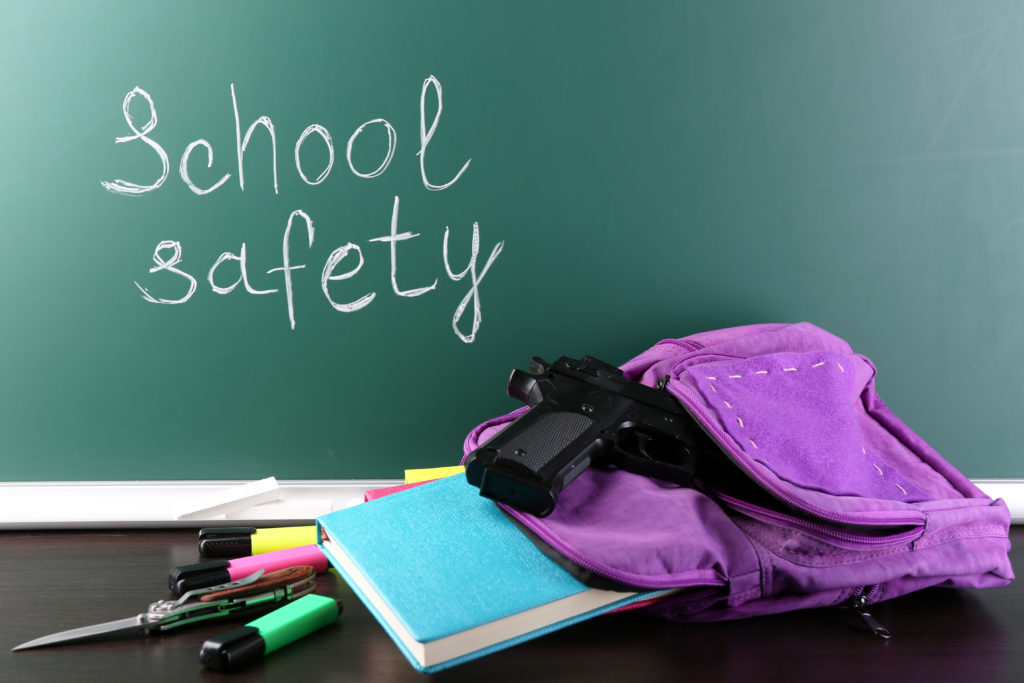
Guntersville-Republican, State Rep. Will Ainsworth on Thursday said he will introduce legislation to allow some public school teachers and administrators to undergo firearms training and arm themselves during school hours, in order to help prevent school shoots like the one that occurred Wednesday at Marjory Stoneman Douglas High School in Parkland, Fla. “Our children are sitting ducks in gun-free schools. As the parent of three public school students, I believe we must act now in order to prevent another tragedy,” Ainsworth posted on Facebook. Ainsworth, who is not seeking re-election in to the State House but is running for Lt. Governor, said he still has research to do before introducing a bill. Once introduced, Ainsworth’s bill would join a handful several others across the nation endeavoring to put more guns in schools for the defense of teachers and students. Similar bills have been filed in Florida, Indiana, Pennsylvania, Mississippi, South Carolina and West Virginia this year alone. If successful, Ainsworth’s bill would just at least nine, which already allow some form of concealed carry in schools.
$6.6 billion Education budget funds pay raise, heads to House floor next week

The Alabama House Ways and Means Education Committee on Wednesday unanimously approved a $6.6 billion education budget on Wednesday. The 2019 Education Trust Fund budget provides a 2.5 percent pay raises for education employees in K-12 and two year colleges, boost funding for pre-kindergarten by $20 million as well as additional programs, and fund 197 more teachers in middle school grades. “This budget reflects high-priority for classrooms and for supporting teachers, and that’s where the money ought to be,” said Interim State Superintendent Ed Richardson during budget talks on Monday afternoon. He said it’s a “strong budget.” Tuscaloosa-Republican and Committee chair state Rep. Bill Poole said he expects the budget to be on the House floor next Thursday. If passed, it will go into effect Oct. 1.
State Dept. of Education announces inaugural state superintendent’s teacher cabinet

After taking the helm of the Alabama State Department of Education (ALSDE) last August, new State Superintendent Michael Sentance called for a new advisory group of educators, which will provide a direct avenue of communication with the state superintendent to discuss important issues regarding education. On Thursday, the ALDSE announced the new group’s — the Superintendent’s Teacher Cabinet for Alabama educators — inaugural members. The selected teachers will serve on the cabinet for one-year terms, with the exception of the soon-to-be-announced 2017-18 Teacher of the Year, who will serve a two-year term. According to the ALDSE, the teachers will meet with Sentance approximately twice each semester, and will also be invited to attend/speak at events pertinent to elevating the teaching profession. There were several hundred applicants, reviewed by ALSDE staff and ultimately chosen by the state superintendent. The inaugural State Superintendent’s Teacher Cabinet includes: Dana Jacobson (Co-Chair) 2016-17 Alabama State Teacher of the Year To be named May 10 (Co-Chair) 2017-18 Alabama State Teacher of the Year Roger Rose Social Studies Teacher Mary G. Montgomery High School, Mobile County Public School System Christy Anders 6th grade Special Education Teacher Muscle Shoals Middle School, Muscle Shoals City School System Michael May Science and Engineering Teacher Athens High School Erica Griffin AP English Language and Composition Teacher Hartselle High School, Hartselle City School System Jennifer Fernandez K-5th grade ESL Teacher Austinville Elementary, Decatur City School System Stephanie Hyatt Reading Teacher and AP English Teacher 9-12th grades Lee High School, Huntsville City Schools Paige Hicks History Teacher Athens High School, Athens City School System Aishia King English/Language Arts Teacher Mary G. Montgomery High School, Mobile County Public School System Brandi Evans 4th grade Teacher W.S. Harlan Elementary School, Covington County School System Andrea Rascoe 6th grade Math Teacher Saraland Middle School, Saraland City School District Julie Ramsay Reading/Reading Intervention, and English Language Arts Teacher Rock Quarry Middle School, Tuscaloosa City School System Jennifer Reaves 6th-8th grade Career and Technical Education Teacher Echols Middle School, Tuscaloosa County School System Darren Ramalho Social Studies/English Teacher, Robert C. Hatch High School, Perry County Schools Kristin Daniel K-2nd grade Art Teacher, Auburn Early Education Center, Auburn Schools Robert Louis Lyda K-2nd grade Music Teacher, Cary Woods Elementary School, Auburn City Schools Judy Hinton Middle School Reading Teacher Birmingham City Schools Rodriquez Leonard 7th grade ELA Teacher John Herbert Phillips International Baccalaureate Academy, Birmingham City Schools Laura Howard Calculus/Algebra II with Trigonometry/Algebra with Finance Teacher Daleville High School, Daleville City Schools Tammy Basaraba 8th grade Science Etowah Middle School, Attalla City Schools Should any Alabama teacher be named a 2017 Milken Educator Award winner, they will automatically be added to the advisory group.
Alabama drops ranks, is far from one of the best states for teachers
Things aren’t looking good for Alabama educators — the state is moving in the wrong direction when it comes to the “best and worst states for teachers.” According to a new study of 2016’s Best & Worst States for Teachers from personal finance website WalletHub, Alabama ranks 34th among the 50 states and the District of Columbia. That’s down four spots from last year’s ranking when the state ranked 30th on the list. The ranking reportedly measures the states against 16 criteria the WalletHub staff feels makes a state a good place for a teacher to be employed in a public elementary or secondary-school classroom. “In order to help educators find the best teaching opportunities in the country and draw attention to the states needing improvement in this regard, WalletHub analyzed the 50 states and the District of Columbia across 16 key metrics, ranging from the average starting salary, to pupil-to-teacher ratio, to school safety,” the report read. Alabama scored 48.35 points, coming in 34th overall. The state ranked 29th for job opportunities and competition, and number 24 for academic and work environment. According to the National Education Association (NEA) statistics, about a fifth of all newly minted public-school teachers leave their positions before the end of their first year — nearly half of them never last more than five. Many teachers, especially novices, transfer to other schools or abandon the profession altogether “as the result of feeling overwhelmed, ineffective, and unsupported,” according to ASCD. It’s therefore no surprise the high turnover rate among K–12 teachers has been likened to a revolving door. Hawaii is ranked as the worst state for teachers, while New Jersey was ranked as the best. Here’s how Alabama compares to the other states: Source: WalletHub
Judge: No, teacher-student sex bans are not unconstitutional
An Alabama judge ruled on Tuesday that prohibitions against teachers having sex with students do not violate the Constitution. It may seem obvious, but defense attorneys for Carrie Witt — a Decatur High School teacher and athletics coach charged with having sex with two minors — challenged the principle in a Morgan County District Court proceeding earlier in April. Witt’s counselors, Robert Tuten and Nick Heatherly, filed a motion asking a Judge Brent Craig to throw out their client’s charges on the basis the state law criminalizing student-teacher sexual relationships violate the 1st Amendment to the U.S. Constitution, with its protections of free speech and free association. The judge dismissed that motion, arguing restricting Witt’s right to sex with underage students does indeed limit her rights, but that such a restriction is in the state’s broader interest. “Constitutional liberties may be restrained when the state has a legitimate interest in doing so,” Craig said of his ruling. “The classic example is, while American citizens enjoy the freedom of speech, one cannot yell fire in a crowded movie theater. Freedom of speech can be restricted.” “Teachers are vested with a great deal of trust by the school districts, the parents, the public, and the students themselves,” continued Craig, citing a Kansas case. “Our legislature has sought to preserve that trust by prohibiting teachers from misusing their access to students as a means to obtain sex. A sexually charged learning environment would confuse, disturb, and distract students, thus undermining the quality of education in Kansas.” In other words, though Alabama law deprives her of certain liberties, the state has a valid and defensible reason for doing so. The 42-year-old Witt taught history and social studies and coached the girls’ golf and JV cheerleading squads. The case will continue at a preliminary hearing on May 3, 2016, at 9:00 a.m.
Alabama teachers are getting a raise

Most Alabama teachers will get a 4 percent raise in 2017. Thanks to the Alabama Legislature, which gave final approval to the state’s education budget Thursday. Working teachers and other school employees would get a 4 percent pay raise if they now make less than $75,000 per year, and employees with higher pay would see their pay go up by 2 percent. It’s the first take-home pay increase in years for Alabama public school teachers. Lawmakers have sent the $6.3 billion budget, which provides funding for K-12 schools, community colleges, four-year universities and other programs on to Gov. Robert Bentley for his signature. “Alabama’s future sits in classrooms today, and our state’s teachers and support staff work hard to prepare students for success,” said Bentley after the budget’s passage. “In my State of the State address in February, I prioritized a pay raise for teachers and support staff, and I commend the Alabama Legislature for passing this important piece of legislation. Alabama’s commitment to education is strong, and with this pay raise, state leaders are sending a clear message of support to our invaluable teachers and other support staff,” said Bentley.
Senate committee approves 4 percent teacher raise for Alabama teachers, education budget

An Alabama Senate committee has approved a 4 percent pay raise for most public school teachers, administrators and employees. The Senate Finance and Taxation Education Trust Fund Committee approved a $6.327 billion Education Trust Fund budget, a 5 percent increase over this year, which funds pay raises for teachers and provides additional money to hire new educators and fund transportation. The House unanimously approved the budget early last month. The budget provides for a wide-array of increases for state education, including $14.5 million to Alabama’s top-ranking Pre-K program — a bump from the House-approved $14 million. Further, the budget will fully fund the Public Education Employees Health Insurance Plan (PEEHIP) and bump the funding for teacher supplies from $373.79 to $405.05 per unit, and technology from $63.79 per unit to $169.34 per unit. The Committee also approved a proposal that dictates teachers and employees making less than $75,000 a year would see a four percent pay raise, while those above would see a two percent raise, making this the first take-home pay increase in years for Alabama public school teachers. The committee adopted an amendment offered by Senate budget chairman Arthur Orr (R-Decatur), that included principals and assistant principals in the pay raise. “Principals are the backbone of the schools, and make the trains run on time and we need to attract good leaders to our individual schools,” Orr said. The budget now moves to the full Alabama Senate, where it is expected to be considered as early as Wednesday.
Joe Morton: Attracting and retaining the “best and brightest” teachers is key
Regardless of whether you are a Democrat or a Republican, a conservative or a liberal, all of us want to see improved student achievement year after year after year across all grades and in all schools in Alabama. Attracting and retaining talented educators is a key to achieving that goal, so, in 2015, the Business Education Alliance of Alabama (BEA) commissioned a research report titled “Teachers Matter: Rethinking How Public Education Recruits, Rewards and Retains Great Educators.” A key section of our report concentrated upon teacher evaluations and compared Alabama’s methodology to those of other states across the nation. We discovered that virtually every state, including ours, uses student improvement in academic achievement as a portion of their teacher evaluations. In some states, student achievement counts for as much as half of a teacher’s evaluation, while in Alabama the pilot program that has not been fully developed comprises just 25 percent, but our study revealed that all states feel it is integral to the overall score. Any state utilizing student academic growth for teacher evaluations must have quality assessments that are fair, relevant and remove any hints of bias. Alabama currently utilizes three such assessments – the ACT exam given to all high school students; the ACT Aspire given to all students in grades 3-8; and the National Assessment of Educational Progress (NAEP) funded by Congress and given to a fair sampling of students in grades 4 and 8 in all 50 states. The NAEP is called the “Nation’s Report Card,” and it is the only assessment that measures student progress in every state against a true national norm, but it cannot be used for teacher evaluation purposes since it is a “sampling” assessment. The high school ACT and the ACT Aspire can be used for the student academic growth portion of teacher evaluations, and both are already adopted by the State Board of Education. Alabama has a good student assessment program that provides excellent insight into our areas of strength and areas needing improvement. The latest ACT results from Alabama high schools show that roughly 16 percent of our students were ready for college-level coursework by scoring at benchmark levels in English, Mathematics, Reading and Science. The national average of students making benchmark scores on the ACT is 28 percent. The RAISE Act, which stands for “Rewarding Advancement in Instruction and Student Excellence,” is being sponsored by Senate President Pro Tem Del Marsh (R – Anniston) and calls for several “firsts” in Alabama while also supporting actions already taken by the State Board of Education. If enacted into law, the RAISE Act will make first year teachers the highest paid in the Southeast and attract more young people to the profession of teaching, provide funding to a first year mentoring program to ensure our new teachers are supported by a veteran teacher, create a rewards program for entire school faculties which gives incentives for either maintaining or improving already high quality results or for schools that show notable improvements in student achievement gains and provide bonuses to teachers who work in hard to staff positions in low performing schools, rural schools or both. It also changes the length of time provided for new teachers to attain tenure from the current three years to five. By combining quality teacher evaluations, a recruitment plan for hard to staff teaching jobs, a program for enhancing first year teacher success with a mentoring program, and a school-based rewards program based upon results, the RAISE Act can build a solid pathway to improved student achievement. If we continue to implement needed education reforms and innovations like the RAISE Act in Alabama’s public schools, every student can one day become career and college ready, and the better prepared workforce that results will allow our state’s economy to continue to grow. Teachers Matter! —- Dr. Joe Morton is a former state superintendent of education and currently serves as chairman and president of the Business Education Alliance of Alabama. He may be reached at jmorton@beaalabama.com.
Alabama ranks No. 30 for best state for teachers

Another study, another mediocre ranking for the Yellowhammer State. Released just in time for International World Teachers’ Day on Oct. 5, a new study of the 50 states and the District of Columbia found Alabama ranks the 30th best state for teachers. Conducted by the personal finance website WalletHub, the in-depth analysis found that teachers across the U.S. are shortchanged every year — their salaries consistently fail to keep up with inflation — all the while the law demands they produce better students. The same is true for Alabama. While the study found Alabama’s average teacher starting salary to be $39,346, the 5th best in the country, teacher income growth potential in the state ranks 50th — essentially, Yellowhammer teacher salaries don’t progress with their careers. That statistic doesn’t bode well for improving education across the state. According to the National Center for Education Statistics, nearly one-fifth of all new public school teachers leave their positions before the end of their first year and almost half don’t last more than five years. Without good teachers who are happy to stay in their jobs, the quality of Alabama education is bound to suffer. But Yellowhammer families shouldn’t be too discouraged, there’s hope yet for the state. Earlier this year, the Alabama Legislature passed a $6 billion Education Fund budget that includes a $13 million increase for textbooks and more than $10 million for the Alabama’s nationally acclaimed Pre-K program. Gov. Robert Bentley also signed a law authorizing Alabama’s first charter schools, allowing for the creation of public schools with the ability to develop curriculum and select teachers bound by contracts instead of regulations set by the state. Before this, Alabama was one of only eight states without charter schools, according to the Alabama Coalition for Public Charter Schools. When asked about the latest ranking, Alabama’s State Superintendent of Education, Dr. Tommy Bice told Alabama Today, “Our primary goal is making sure the students of Alabama receive a quality education that adequately prepares them for life after high school, be it college or the workforce. Our teachers are essential in making that happen. We do not focus on rankings and comparisons. Rather we do all that we can to support our teachers, provide research-based professional growth opportunities, provide comprehensive induction and mentoring programs, and invest in efforts to recruit and retain great educators.” “We are faced with unprecedented budgetary struggles and challenging expectations – yet our teachers come to school every day with steadfast dedication and a resolve to make a difference in the lives of our students,” Bice continued. “Making sure our teachers are well-prepared, resourced, supported and effective so they can make sure our students graduate from school prepared for life is our goal. There are an assortment of surveys and rankings from numerous sources that judge and categorize schools and teachers with a wide variety of criteria and methodologies. Our intention is to stay committed to being the best we can be for Alabama students as we meet the goals of Alabama’s plan of continuous improvement – PLAN 2020.” The following are the statistics that were released regarding being a teacher in Alabama and how it ranks with the rest of the United States. (1=Best; 25=Average) Average starting salary for teachers: 5th Median annual salary for teachers: 23rd Teachers’ income growth potential: 50th Projected number of teachers per student by 2022: 15th Unemployment rate: 40th 10-year change in teacher salaries: 10th WalletHub “School Systems” ranking: 39th Pupil-to-teacher ratio: 22nd Safest schools: 13th WalletHub “Underprivileged Children” Ranking: 42nd Public school spending per student: 44th As for how neighboring states fared, Alabama was in good company — Mississippi ranked 48th, Georgia 37th, Tennessee 33rd, and Florida 27th. Source: WalletHub
