
Donald Trump’s tariffs could sow trouble for GOP in farm districts
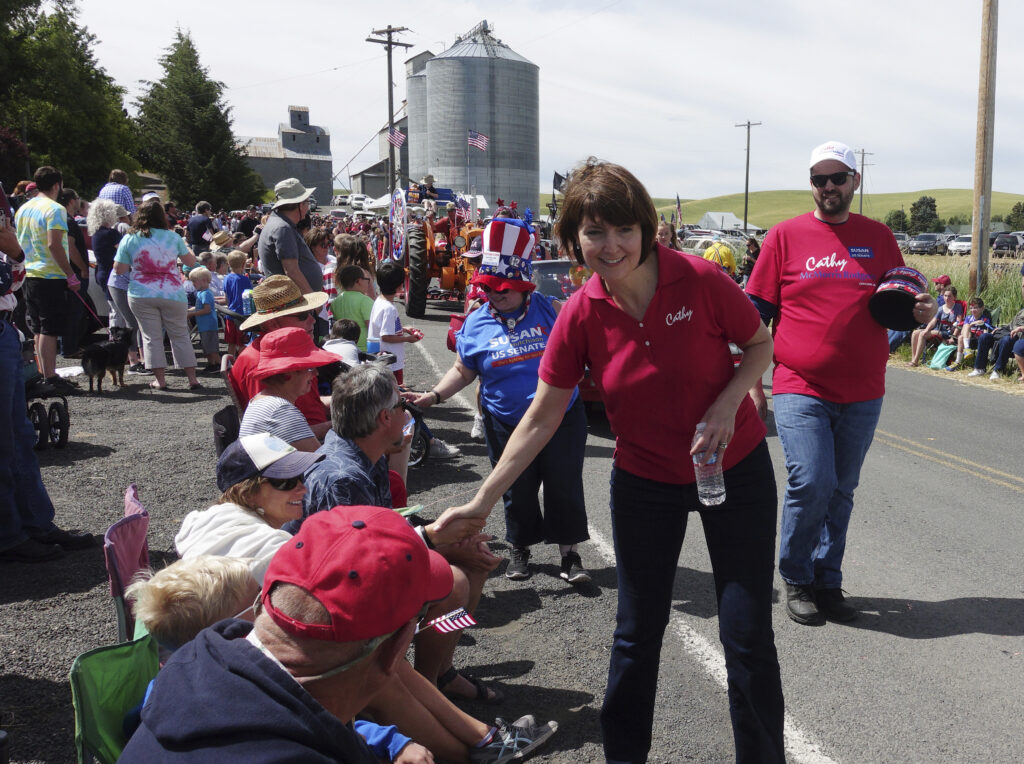
In the aptly named Harvester Restaurant, wheat farmer Roy Dube makes clear he’s no fan of President Donald Trump‘s trade policy. “We get him elected into office and he pulls us out of trade agreements,” Dube said last week as local farmers gathered to hear Democratic House candidate Lisa Brown. Dube says China is buying less wheat from eastern Washington farmers and Trump’s policies have opened the door for Australia and Canada to wrestle away business. His frustration extends to his congressional representative, Rep. Cathy McMorris Rodgers, who is the highest-ranking Republican woman in the House and running for an eighth term. “I’m concerned that Cathy McMorris Rodgers didn’t put up more resistance,” Dube said. The U.S. tariffs on agriculture products, sown by Trump, have grown into an election-year threat to Republicans in rural districts that are heavily reliant on exports for their economy. With the livelihoods of farmers at risk, opposition to the tariffs could make a difference in some races and help determine which party takes control of Congress. McMorris Rodgers has made it clear she opposes the president’s actions on tariffs, but so far, the Republican-controlled House has not taken up legislation to block them. Democrats characterize GOP lawmakers as unable or unwilling to check Trump, who has declared that “tariffs are the greatest.” “My opponent, though she would say she’s concerned and talking to the administration about these issues, she’s still mostly a cheerleader for the president,” said Brown, a former state legislator. Facing what appears to be the tightest re-election race of her career, McMorris Rodgers is emphasizing that she has encouraged the president to “move from tariffs to agreement.” “I have made it very clear that I don’t support the across-the-board tariffs, that we should take a more targeted approach,” McMorris Rodgers told The Associated Press. Clues that the president’s trade policies will play a role in the November midterm elections can be seen in Agriculture Secretary Sonny Perdue‘s travel schedule. Over the past few months, he’s been to Eastern Washington to join McMorris Rodgers in meeting with farmers. He’s also been to California’s Central Valley to meet with farmers in the districts of Republican Reps. Jeff Denham and David Valadao. He also went to Iowa, where Republican Reps. David Young and Rod Blum are both in close races. The battle for the Senate could also be affected by the tariff issue, particularly in North Dakota, Indiana and Missouri, where Republicans hope to knock off three Democratic incumbents. The president has tried to allay farmers’ concerns with an aid package of up to $12 billion to help them weather the trade war. J. Read Smith, a rancher near St. John, Washington, said he shares Trump’s goal of seeking a level playing field in trade. “But antagonizing our trading partners is not the way to do it,” said Smith, who emphasized that he is not a Democrat. “I’m an American.” Aaron Flansburg, who runs a diversified farm near Pullman, Washington, said he’s skeptical the tariffs will change the way most farmers vote, though. “Farmers often vote for Republicans,” Flansburg said. “Whether that will change, I have my doubts.” McMorris Rodgers said it’s her sense that voters are willing to give the president time to negotiate better agreements. “Yes, there’s a lot of uncertainty. There’s a sense that we need to get these trade agreements into place as soon as possible, but there’s also a recognition that for too long America has not taken action, especially against China,” she said. In July, the United States began imposing a tax on $34 billion in Chinese imports. Last month, it added tariffs to $16 billion in Chinese goods and is readying taxes on an additional $200 billion worth. China retaliated with its own tariffs on U.S. products. The world’s two biggest economies are clashing over allegations that China steals technology from American companies. The Trump administration also announced that it will begin taxing $200 billion in Chinese goods starting Monday. The tariffs will start at 10 percent and rise to 25 percent in 2019. The Trump administration also imposed a 25 percent tariff on imported steel and a 10 percent tariff on imported aluminum that included imports from the European Union, Canada and Mexico — and just about everyone else — in the name of national security. Those tariffs also drew retaliation. For example, the EU targeted bourbon, a key industry in Senate Majority Leader Mitch McConnell‘s home state of Kentucky, where Republican Rep. Andy Barr and Democratic challenger Amy McGrath are battling in a close election. Overall, about 6 in 10 Americans disapprove of how the president is handling trade negotiations with other countries. Farm groups have testified in congressional hearings that retaliatory tariffs increase the cost of their products for customers abroad, giving foreign competitors an edge. “The current tariffs, continuing back-and-forth retaliatory actions and trade uncertainties are hitting American agriculture from all sides and are causing us to lose our markets. Once you lose a market, it is really tough to get it back,” said Kevin Paap, president of the Minnesota Farm Bureau. Rep. Ben Ray Lujan, who is overseeing Democratic efforts in House races, pointed to Iowa as a state where he believes the administration’s tariffs could backfire. He said primary turnout was up, in part because small family farmers and the businesses they buy from are worried. “I really believe that in those districts, you’ll see people come forward and hold everyone accountable not standing up for them,” Lujan said. GOP lawmakers from Iowa, including Young and Blum, signed onto a letter calling on the president to act quickly to save rural economies. Blum also wrote Trump separately urging him to “consider the consequences tariffs have on American manufacturers.” When the president visited Blum’s district a few days later, he thanked him for his “political courage” on trade. “You’ve taken some heat for it in the short term, but in the long run, the farmers, the manufacturers, the employers are all going
World jittery about Donald Trump’s ‘America first’ inaugural speech

President Donald Trump‘s inaugural speech promised “America first” policy led by a forceful executive, in contrast to the coalition building and international conferences which have featured strongly in past administrations. The billionaire businessman and reality television star — the first president who had never held political office or high military rank — promised to stir a “new national pride” and protect America from the “ravages” of countries he says have stolen U.S. jobs. “This American carnage stops right here,” Trump declared. In a warning to the world, he said, “From this day forward, a new vision will govern our land. From this moment on, it’s going to be America first.” A look at some reactions from around the world: ___ AFGHANS DISAPPOINTED BUT HOPEFUL Like many in the Afghan capital of Kabul, restaurant owner Mohammad Nahim watched the presidential inauguration ceremonies but was disappointed to not hear any mention of Afghanistan. “Trump did not mention a word about Afghanistan in his speech and the salaries of the Afghan army and police are paid by the U.S.,” he said. He added that if the U.S. stops helping Afghanistan, “our country will again become a sanctuary to terrorists. I hope Trump will not forget Afghanistan.” Mohammed Kasim Zazi, a shopkeeper whose home is in eastern Afghanistan’s Khost province, where the feared Haqqani network is prominent, said he expected Trump to stay focused on Afghanistan. “Trump said he will finish the terrorists in the world and that has to mean that Afghanistan will remain in the sights of the U.S.” said Zazi. Chief Executive Abdullah Abdullah said he was encouraged by Trump’s speech to soldiers in Bagram. “There he announced his support to the troops and the continuation of support for their troops here and strengthening their troops, which is a good and elegant step and I am sure that our cooperation in other areas will continue as well.” ___ SPEECH RESONATES IN MEXICO Perhaps no country was watching the speech more closely than Mexico. Trump has made disparaging remarks about immigrants who come to the United States illegally and sought to pressure companies not to set up shop in Mexico by threatening a border tariff on goods manufactured there and exported to the United States. So Trump’s talk of “protect(ing) our borders,” ”America first” and “buy American and hire American” had particular resonance in America’s southern neighbor. Ricardo Anaya Cortes, president of the conservative opposition National Action Party, called for “the unity of all Mexicans, unity in the face of this protectionist, demagogic and protectionist speech we just heard. Unity against that useless wall, against deportations, against the blockade of investment.” “The challenge is enormous. … We demand the federal government leave aside tepidity, that it tackle with absolute firmness and dignity the new relationship with the United States,” Anaya said. The United States is by far Mexico’s largest commercial partner, buying some 80 percent of its $532 billion in exports in 2015. Mexico is the second-largest market for U.S. exports. “At least the word ‘Mexico’ was not heard in the speech. Nevertheless one can expect the United States to launch a hyper-protectionist project,” said Ilan Semo Groman, a researcher at Iberoamericana University. If Trump truly moves to block or drive away U.S. investment in Mexico, Semo said Mexico should focus its commercial efforts on other countries. “There are very clear possibilities,” Semo said. Mexican President Enrique Pena Nieto sent three tweets after Trump’s inaugural speech Friday: — “I congratulate @realDonaldTrump on his inauguration. We will work to strengthen our relationship with shared responsibility.” — “We will establish a respectful dialogue with the government of President @realDonaldTrump, to Mexico’s benefit.” — “Sovereignty, national interest and the protection of Mexicans will guide the relationship with the new government of the United States.” ___ PAKISTAN WORRIES ABOUT MUSLIM COMMENTS A group of retired government officials gathered after morning prayers for a walk in a sprawling park in the heart of the federal capital of Islamabad and the topic of their conversation was President Trump’s inaugural speech. They expressed concern that Trump would target the Islamic world, particularly Pakistan, because of his campaign rhetoric about Muslims as well as his inaugural speech in which he promised to eradicate Islamic terrorism worldwide. Pakistan has often been accused of harboring militant insurgents and declared terrorist groups that have targeted neighboring India, against whom Pakistan has fought three wars, as well as Afghanistan. Pakistan denies the charges. “Likely there is more trouble in store for the Islamic world and our country will take the most brunt of the harsh treatment from President Trump administration,” said Mohammad Afzal. His sentiments were echoed by Shafiq Khan, who said “the one main thing that the new president mentioned about the world outside America is to tackle Islamic radicalism and that should be the matter of concern for all of us.” Amanaullah, a school teacher in Islamabad, feared Trump’s reference to eliminating radical Islamic terrorism. “I think under this name he wants to malign and eliminate Islam,” he said. Umair Khan, an engineer, said of Trump: “Let him taste the burden of government and get settled, I am sure he will calm.” ___ CONCERN IN TOKYO Some Tokyo residents are worried that Trump’s “America first” policy will usher in an era of populism and protectionism at the expense of the rest of the world. Tadashi Gomibuchi, who works in the manufacturing industry, recorded Trump’s inauguration speech overnight as he was keen to hear what the new president had to say. “Trump is trying to make big changes to the way things are. Changes are good sometimes, but when America, the most powerful, loses stability … it’s a grave concern,” he said. “If you take his words literally, it may destabilize the world going forward and I’m really worried. I hope things will lead to a soft landing.” Retiree Kuninobu Inoue, who lived in the U.S. during the 1990s, is concerned about trade frictions between Japan and the U.S, citing Trump’s decision
Analysis: In debate, Hillary Clinton was prepared, Donald Trump was Trump

She was at her best. He was not at his worst. Weeks of Super Bowl-style hype aside, Monday night’s 90 minutes of heated clashes between Hillary Clinton and Donald Trump probably didn’t shove many undecided voters off the fence. If Clinton aimed to push her famously unpredictable opponent into a made-for-sharing disqualifying moment, she didn’t quite get there. If Trump set out to show America — particularly women — he’s completed the transformation from cartoonish pop culture staple to leader worthy of the Oval Office, he still has a way to go. But in a debate full of feisty exchanges and a personal scuffle or two, the candidates demonstrated clearly how they’ve gotten this far. Clinton was polished, prepared and proud of it —a Hermione Granger at a podium. She came with sharp and practiced answers, most notably a newly direct one for the questions about her private email server that has dogged her candidacy for months. She grinned broadly and calmly, even when under fire, and she mocked but only gently the man she called “Donald.” “I think Donald just criticized me for preparing for this debate. And, yes, I did,” Clinton said. “And you know what else I prepared for? I prepared to be president. And I think that’s a good thing.” Trump addressed his opponent as “Secretary Clinton” — even asking for her approval for the term — but by the end he called her “Hillary.” The care he took with her title was a reminder of the voters he was aiming to win over. Women, particularly college-educated white women, are the key to Trump turning his current burst of momentum into a sustained surge that lasts until Election Day. The 70-year-old businessman has struggled to persuade women, even those with doubts about the first woman president, to get behind his bid, thanks in part to his performances in past debates, which led to cringe-worthy challenges to moderator Megyn Kelly or opponent Carly Fiorina. Trump avoided another jaw-dropping, decorum-busting moment on Monday night, but it was hard to see that he did much to soften his image. He repeatedly and aggressively interrupted Clinton to rebut or deny her charges, at times talking over her or interrupting. When asked by moderator Lester Holt to explain a previous comment that Clinton doesn’t have a “presidential look,” Trump simply repeated the comment. “She doesn’t have the look. She doesn’t have the stamina,” he said. “To be president of this country, you need tremendous stamina.” Clinton came prepared to pounce: “Well, as soon as he travels to 112 countries and negotiates a peace deal, a cease-fire, a release of dissidents, an opening of new opportunities in nations around the world, or even spends 11 hours testifying in front of a congressional committee, he can talk to me about stamina.” As the debate went on, Clinton seemed to gain confidence and a better sense of timing. When Trump concluded a long and tangled defense of his years-long campaign to challenge President Barack Obama’s citizenship, she paused for a moment to let Trump’s words sink in. “Well, just listen to what you heard,” she said. Trump, too, had his moments. He delivered a searing indictment of Clinton as just another insider proposing the same-old solutions for an economy on the brink of “crashing down.” The riff was a potent reminder of why his candidacy has become a vehicle for the alienated white Americans feeling pinched by the economy and forces of globalization. “Typical politician. All talk, no action. Sounds good, doesn’t work. Never going to happen,” he said, encapsulating the core message of his campaign. He showed Clinton remains vulnerable on her support for trade deals, forcing Clinton in her clearest fib of the night when she denied having called the Trans-Pacific Partnership the “gold standard” of trade agreements and claimed she merely said she hoped it would be a good deal. But Trump missed opportunities to dive into Clinton’s other vulnerabilities. She was also able to make swift work of her email scandal, saying simply “It was a mistake and I take responsibility for that.” “That’s for sure,” Trump interjected, but left it there. The Republican didn’t raise Clinton’s description of half of his supporters as “deplorables” or the Clinton Foundation and its donor network. That left Clinton largely free to play the prepared grown up to Trump’s agitated upstart. Even Trump granted her that: “She’s got experience,” he said. “But it’s bad experience. And this country can’t afford to have another four years of that kind of experience.” Republished with permission of the Associated Press.
Updates from the 1st presidential debate

The Latest on the first of three presidential debates between Democrat Hillary Clinton and Republican Donald Trump (all times EDT): 10:45 p.m. Both candidates concluded the first presidential debate by saying they will accept the outcome if the other wins. Hillary Clinton spoke directly to viewers and said, “It’s not about us, it’s about you.” Donald Trump initially dodged the same question, saying he would make a “seriously troubled” America “great again.” He added: “I’m going to be able to do it. I don’t believe Hillary Clinton will.” But Trump finished his answer by saying that if Clinton wins, “I will absolutely support her.” ___ 10:43 p.m. Hillary Clinton is punching back at Donald Trump’s assertions that she doesn’t have the “stamina” to be president. Trump has questioned whether Clinton has the physical fitness to be president and he repeated the criticism to her directly during the debate. Clinton’s response? Trump shouldn’t talk about stamina until he’s tried out the busy schedule she kept up as secretary of state. Trump didn’t answer moderator Lester Holt’s original question about his past comments that Clinton doesn’t have the “presidential look.” Clinton suggested the remarks were about gender, and she reminded the crowd of Trump’s past comments calling women “pigs” and other derogatory names. ___ 10:42 p.m. Donald Trump says NATO needs to “go into the Middle East with us” to combat the Islamic State group. And he is taking credit for NATO focusing resources on combating terrorism. In fact, the alliance agreed in July to contribute aircraft and conduct training in Iraq and has increased intelligence coordination there. And NATO set up an anti-terrorism program in 2004 — years before Trump criticized them as a presidential candidate. Earlier this year, Trump criticized NATO for not focusing on terrorism. He said that afterward, he saw an article reporting that NATO was opening a new, major anti-terrorism division. He said Tuesday that NATO’s action was “largely because of what I was saying, and my criticism of NATO.” ___ 10:40 p.m. Donald Trump is avoiding a specific declaration on how he would use nuclear weapons if he’s elected president. The Republican nominee said during the first presidential debate that he “would not do first strike” because “once the nuclear alternative happens, it’s over.” That statement suggests he would not authorize a nuclear attack unless the U.S. was struck first. But in the same answer Trump said he “can’t take anything off the table.” He mentioned adversary nations such as North Korea and Iran. President Barack Obama has considered changing existing policy to state clearly that the United States would not deploy nuclear weapons without first being attacked by nuclear weapons. But he met resistance and has elected not to make such a shift. ___ 10:38 p.m. Hillary Clinton is accusing Donald Trump of being too easily provoked to keep the United States from going to war — perhaps even one involving nuclear weapons. Trump says: “I have much better judgment than she does. I have much better temperament.” That drew laughs from some in the debate crowd, and prompted Clinton to exclaim: “Woo! OK!” Clinton then pivoted to policy, defending the U.S.-led war in Afghanistan. Clinton said Iran was “weeks away” from a nuclear bomb when she became secretary of state — and says the Obama administration thwarted that progress. She continued that Trump didn’t have “good judgment or the right temperament” because he could take the country to war over small issues, like being mocked on Twitter. ___ 10:35 p.m. Donald Trump is continuing to insist he opposed the Iraq War before the U.S. invasion despite evidence to the contrary. Trump says during the debate that he “did not support the war in Iraq,” calling that charge “mainstream media nonsense.” But there is no evidence Trump expressed public opposition to the war before the U.S. invaded. Trump was asked in September 2002 whether he supported a potential Iraq invasion in an interview with Howard Stern. Trump briefly hesitated, then responded: “Yeah, I guess so.” Presented with the comment during the debate, Trump responds: “I said very lightly, I don’t know, maybe, who knows.” He’s also telling reporters to call Fox News host Sean Hannity to confirm private conversations he said they had about the war. Hannity is a top Trump supporter. Clinton voted in favor of the invasion in 2002 while she was a New York senator. She has since said it was a mistake. ___ 10:27 p.m. Donald Trump is interrupting the moderator of the first presidential debate to insist he has the best temperament for the office. Trump repeatedly made the assertion after clashing with moderator Lester Holt over his early support for the Iraq War. Then he segued to his temperament. “I think my strongest asset by far is my temperament,” Trump said. “I know how to win.” Clinton and her allies have repeatedly hit Trump over his temper and inability to take criticism. ___ 10:23 p.m. Hillary Clinton says one key to fighting terrorism in the United States is working closely with Muslims living here. Clinton says Donald Trump has “consistently insulted Muslims abroad, Muslims at home.” She says Muslim people can provide information that law enforcement may not be able to obtain anyplace else. Both candidates were asked to explain how they would combat terrorism in the U.S. Clinton says her plan includes an intelligence surge to obtain “every scrap of information” and to “do everything we can to vacuum up intelligence from Europe, from the Middle East.” ___ 10:20 p.m. Hillary Clinton says defeating the Islamic State group and taking out its leaders would be a top priority as president. Clinton says she’s hopeful the Islamic State group would be pushed out of Iraq by the end of the year. She says the U.S. could then help its allies “squeeze” the terrorist group in Syria. Clinton says she would do everything possible to take out the group’s leaders, and make that one of her administration’s organizing principles
Venturing to Mexico, Donald Trump defends right to build huge wall

On Mexican soil for the first time as the Republican presidential nominee, a firm but measured Donald Trump defended the right of the United States to build a massive border wall along its southern flank, standing up for the centerpiece of his immigration plan in a country where he is widely despised. Trump, who previously derided Mexico as a source of rapists and criminals, praised Mexicans Wednesday as “amazing people” following a closed-door meeting at the official residence of the country’s president, Enrique Pena Nieto. Trump and the Mexican president, who has compared the New York billionaire to Adolf Hitler, addressed reporters from adjacent lecterns before a Mexican flag. The trip, 10 weeks before America’s presidential Election Day, came just hours before Trump was to deliver a highly anticipated speech in Arizona about illegal immigration. That has been a defining issue of his presidential campaign, but also one on which he’s appeared to waver in recent days With political risks high for both men, Trump stayed on script, declining to repeat his promise to force Mexico to pay for a wall along the border between the two countries when pressed by reporters. While he and Pena Nieto talked about the wall, Trump said they didn’t discuss who would pay for a cost of construction pegged in the billions. “Having a secure border is a sovereign right and mutually beneficial,” Trump said, reading from prepared remarks. “We recognize and respect the right of any country to build a physical barrier or wall on any of its borders to stop the illegal movement of people, drugs and weapons. Cooperation toward achieving this shared objective — and it will be shared — of safety for all citizens is paramount to both the United States and to Mexico.” Trump’s presence on Wednesday, his first meeting with a head of state abroad as a presidential candidate, sparked anger and protests across Mexico’s capital city. Former Mexican President Vicente Fox bluntly told the celebrity businessman that, despite Pena Nieto’s hospitality, he was not welcome. “We don’t like him. We don’t want him. We reject his visit,” Fox said on CNN, calling the trip a “political stunt.” Pena Nieto was less combative as he addressed reporters alongside Trump. He acknowledged the two men had differences and defended the contribution of Mexicans working in the United States, but he described the conversation as “open and constructive.” He and Trump shook hands as the session ended. Pena Nieto’s performance came in for immediate condemnation from his many critics in Mexico. “Pena ended up forgiving Trump when he didn’t even ask for an apology,” said Esteban Illades, the editor of Nexos magazine. “The lowest point of the most painful day in the history of the Mexican presidency.” After saying during his Republican primary campaign he would use a “deportation force” to expel all of the estimated 11 million people living in the United States illegally, Trump suggested last week he could soften that stance. But he still says he plans to build a huge wall — paid for by Mexico — along the two nations’ border. He is under pressure to clarify just where he stands in the Wednesday night speech, which had been rescheduled several times. Trump’s running mate, Indiana Gov. Mike Pence, told CBS earlier in the day that Trump would make clear “that there will be no path to legalization, no path to citizenship. People will need to leave the country to be able to obtain legal status or obtain citizenship.” The buildup to the speech was abruptly interrupted Tuesday night by the news that Trump would visit Mexico, accepting on short notice an invitation offered last week by Pena Nieto. The newspaper El Universal wrote in an editorial that Trump “caught Mexican diplomats off guard.” Campaigning in Ohio earlier in the day, Democrat Hillary Clinton jabbed at Trump’s Mexican appearance as she promoted her own experience working with foreign leaders as the nation’s chief diplomat. “People have to get to know that they can count on you, that you won’t say one thing one day and something totally different the next,” she told the American Legion in Cincinnati. “And it certainly takes more than trying to make up for a year of insults and insinuations by dropping in on our neighbors for a few hours and then flying home again.” Trump has promised, if elected, to deport millions of immigrants who are in the United States illegally, force Mexico to pay for the construction of a wall to secure the nearly 2,000-mile border and renegotiate the NAFTA trade agreement to make it more favorable to the United States. Pena Nieto suggested there was room to improve the trade deal, which Trump described as unfair to American workers. The New York businessman promised to promote trade deals that would keep jobs in the Western Hemisphere. Pena Nieto made his invitation to both Trump and Clinton, who met with him in Mexico in 2014. The inclusion of Trump puzzled many in Mexico, who said it wasn’t clear why their own unpopular president would agree to meet with someone so widely disliked in his country. Pena Nieto has been sharply critical of Trump’s immigration policies, particularly the Republican’s plans to build a wall and have Mexico pay for it. In a March interview, he said that “there is no scenario” under which Mexico would do so and compared Trump’s language to that of dictators Hitler and Benito Mussolini. Pena Nieto did not repeat such criticism on Wednesday, but acknowledged Trump’s comments had “hurt and affected Mexicans.” “The Mexicans deserve everyone’s respect,” he said. Republished with permission of The Associated Press.
Senior Jeff Sessions staffer joins Donald Trump’s presidential campaign; Session says US needs “strong negotiator”

The communication director for Sen. Jeff Sessions, Stephen Miller, has joined the presidential campaign of Donald Trump as a senior policy advisor, deepening the already well-worn ties between Alabama’s junior senator and Trump’s 2016 bid for the White House. The same day Miller moved to the campaign, his erstwhile boss again spoke out in support of Trump, touting their common opposition to the Obama administrations Trans Pacific Partnership trade deal. Sessions, briefly donning one of Trump’s signature red “Make American Great Again” caps, told Republicans set to vote in Iowa’s first-in-the-nation caucuses on February 1 that Trump has fought admirably against Obama on trade policy, though he stopped short of formally endorsing him “We need to negotiate better,” Sessions said. “So, what I’d say to the people in Iowa: ‘This is a matter of supreme importance that neither party should nominate a candidate who does not oppose this agreement. You can be for trade, you can be for negotiating agreements with countries around the world but not this way and not creating these kinds of transnational commissions that only hamper the United States as we go forward in the decades.’” Miller’s move was lauded by conservative pundit Ann Coulter, who Tweeted upon reading news of the personnel shift: “I’M IN HEAVEN! Trump hires Sen. Sessions’ brain trust, Stephen Miller. He’s not backing down on immigration.” Both Trump and Sessions have nearly in lock-step when it comes to immigration, with both men taking a hard line against accepting refugees from war-torn Syria and in favor of deporting undocumented immigrants.
