
Alabama in the middle of the pack when it comes to women’s equality
Women’s rights in the U.S. have made leaps and bounds since the passage of the 19th Amendment. Yet many women still struggle to crack the proverbial glass ceiling. Across the country, women’s equality in pay and job opportunities varies and America is losing ground globally, according to the personal finance website WalletHub, which in their latest study “2016’s Best & Worst States for Women’s Equality” ranked the states for gender equality. The study found Alabama was neither among the best, nor the worst states in gender equality, ranking number 35. WalletHub analysts compared three key metrics in determining each state’s rank: workplace environment, education and political empowerment. In the first metric, Alabama ranked 41st, for its high disparity of employees in executive positions by gender (with the fourth-worst score in this category), gap in number of minimum-wage workers and gap in number of entrepreneurs by gender. The Yellowhammer State ranked fourth in education — a high point of the findings. And when it comes to political empowerment, Alabama has room for improvement, coming in at 37th. Apart from unequal representation in executive leadership, salary inequity also has been central to the gender-gap debate. “Few experts dispute the existence of an earnings gap between women and men, but accurately measuring the disparity remains a challenge,” WalletHub writes. “The fact remains, however, that about two-thirds of minimum-wage workers across the country are female, according to the National Women’s Law Center. Unfortunately, women still have too few voices in government to help them achieve full social and economic equality in the near future.” This study comes just three days ahead of Women’s Equality Day on Aug. 26, a date selected to commemorate the 1920 certification of the 19th Amendment to the Constitution, granting women the right to vote. Here’s a look at how Alabama compares to the rest of the country: Source: WalletHub
NRA ad claims Hillary Clinton is threat to gun rights
The Latest on the Democratic National Convention (all times EDT): 7:45 p.m. On the same day Hillary Clinton is set to claim the Democratic presidential nomination, the National Rifle Association is coming out with an ad saying Americans’ “right to own a gun for self-defense is at risk in this election.” The group says it plans to begin airing the 30-second ad on Thursday. It features a rape victim who confronted President Barack Obama over gun right at a town hall meeting this year. She tells viewers that “self-defense is your right. Don’t let it be taken away.” Word of the ad campaign comes as the Democratic Convention features speeches Wednesday night from relatives of the nightclub shooting in Orlando, Florida, and the 2012 shootings at Sandy Hook Elementary School in Connecticut. The ad’s narrator says Clinton “would take away your rights.” 7:30 p.m. Some Hillary Clinton supporters at the Democratic convention are becoming noticeably agitated by the continued protests of Bernie Sanders‘ most vocal supporters. Danielle Adams is a Clinton delegate from North Carolina. She says, “I’m so exhausted by it.” Some in the Colorado delegation at the Wells Fargo Center have scratched out letters in signs that say “Stronger Together” – and those signs now say “stop her.” Delegates from Louisiana and Delaware are standing in front of them holding their own signs and attempting to block the view. In California, an older woman in tears had to be led out of the arena because she was upset by some of the protesting Sanders backers. Cheryl Brown is a state representative from California. She says the way some Sanders delegates are behaving is exacerbating tensions between the two campaigns. 7 p.m. Harry Reid is speaking at his final Democratic National Convention as a senator, and the Senate’s Democratic leader is blasting Republicans and Donald Trump for wanting to – in his words – “tear down the pillars of middle-class security.” The retiring Nevada lawmaker has some harsh words for the Senate’s Republican leader, Kentucky’s Mitch McConnell. Reid says McConnell and the GOP have slandered the country’s first black president, whipped up fear of Muslims and sown hatred of Latinos. Reid says parents are right to worry about their kids hearing what comes out of Trump’s mouth. He says Trump learned it from watching Republicans. 6:50 p.m. Movie director James Cameron is calling Donald Trump “a madman,” and “incredibly reckless, incredibly dangerous” when it comes to global warming. The director of “Titanic” and “Avatar” has made a short film – airing Wednesday night at the Democratic convention – about how climate change is harming the United States. The film shows wildfires, heat waves and the aftermath of Superstorm Sandy – and then segues to Trump calling man-made global warming a hoax. Cameron tells reporters that attacking Trump on his rejection of mainstream climate change science is a winning strategy for Democrats. He calls Trump’s positions “incredibly reckless, incredibly dangerous” and later refers to Trump as “a madman saying we’re going to tear up” the landmark climate change agreement negotiated in Paris. 6:35 p.m. The Rev. Jesse Jackson says Hillary Clinton can be trusted to fight for issues such as a fair Supreme Court, gun control and progressive policies. The former presidential candidate says Clinton understands the impact of the Black Lives Matter movement and the shooting deaths of Trayvon Martin, Michael Brown and Alton Sterling. Jackson also is congratulating Bernie Sanders for energizing the campaign with “ideas and hope.” In Jackson’s words: “The Bern must never grow cold.” Still, he says, “It’s healing time. It’s hope time. It’s Hillary time.” 6:30 p.m. California’s governor is criticizing Donald Trump for failing to mention the words “climate change” or “global warming” during his acceptance speech at the Republican convention. Jerry Brown says it’ll take “heroic efforts on the part of many people and many nations” to combat climate change. But, the Democratic governor adds, “You wouldn’t know it by listening to Donald Trump.” Brown is speaking at the Democratic convention later Wednesday, and in his prepared remarks, he notes Trump has called global warming a hoax. That’s why Brown isn’t holding back: “I say Trump is a fraud.” Brown’s also disputing Trump’s assertion there’s no drought in California – only water mismanagement. Brown’s response: “I say Trump lies.” He says Trump and others who reject climate science “are dead wrong – dangerously wrong.” 6 p.m. President Barack Obama has a message for fellow Democrats, and all those watching the Democratic convention at home: There’s never been a man or a woman more qualified than Hillary Clinton to serve as president. It’s a theme Obama is stressing in his convention speech later Wednesday night. According to the White House, Obama plans to say “nothing truly prepares you for the demands of the Oval Office.” He intends to vouch for Clinton as someone who’s been part of his biggest decisions in the Oval Office and a leader who never quits – no matter the odds or “how much people try to knock her down.” The president is set to describe his 2008 campaign rival as someone who listens to people, keeps her cool and treats everybody with respect. Obama says, “that’s the Hillary I’ve come to admire.” 5:50 p.m. President Barack Obama plans to tell the Democratic convention that the America he knows is “full of courage and optimism and ingenuity.” The White House released a preview of Obama’s Wednesday speech to the convention a few hours before he’ll address delegates in Philadelphia. Obama says Americans have “real anxieties,” including paying their bills, protecting their children, frustrations with political gridlock and racial divisions. But he says during his travels as president, he’s “seen, more than anything, is what is right with America.” That includes people working hard and “a younger generation full of energy and new ideas.” 5:31 p.m. Six drafts and a few late nights went into the speech President Barack Obama will give at the Democratic convention. White House officials
Entrepreneurial Alabamian Amanda Latifi’s app is shaking things up
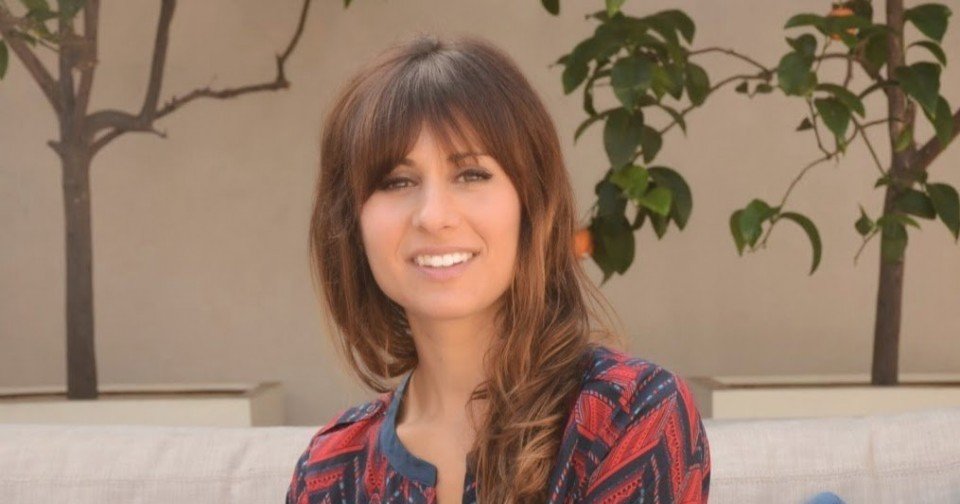
In a recent interview with AL.com, Huntsville native Amanda Latifi doled out pieces of wisdom and advice she’s accrued since beginning Hafta Have, a startup in California’s tech-rich Silicon Valley. The daughter of an Iranian immigrant who is an entrepreneur himself, Latifi comes by her chosen profession naturally. “A child of an entrepreneur and engineer, I think I just inherited some of those ‘I must create’ genes,” she told AL.com’s Lucy Berry. Those genes and her own hard work have served Latifi well, earning her company success in relatively short order. An alumna of Huntsville’s Grissom High School and Birmingham-Southern College, Latifi’s didn’t start out looking to be an acclaimed tech entrepreneur “I started out at ad agencies,” said Latifi. “I was a brand strategist for companies like McDonald’s, Skittles, Glade. So, did I start in tech or plan on being here? No. “But, in my previous career I was always more attracted to product innovation and the digital space. I left it behind to join a LA entertainment startup lab founded by Scooter Braun (the manager of Justin Bieber, Tori Kelly, Ariana Grande, etc.) and Ori Birnbaum. We were backed by some heavy hitters: Mark Cuban, Google Ventures, KPCB, Deep Fork, Yuri Milner, etc. I was one of the first hires at the fan club app called Fahlo, now Bkstg. After almost two years of what I would call a crash course in all things tech and startups, I hit a wall. I encountered the burnout everyone previously warned me about. I made the decision to leave, because I honestly didn’t have the passion for the product anymore.” But Latifi’s shopping habit, and desire to work in tech on her own terms led to the innovative app, which was named Best New App in the App Store last week. Here’s how it works: As you go shopping and see items that you love, but aren’t at a price you necessarily want to dole out, scan the items into the app. Hafta Have will store the list for you, and alert you when those pieces are on sale. “We’re a new way to shop,” says the app’s website, “developed (by women) out of what was missing. Lots of us ‘In-store Shoppers’ take pictures of clothes and their tags, so we’ll remember to go back when they’re on sale…regrettably, that’s rarely the case. How dare we leave behind the things we Hafta Have™.” While the app has already earned acclaim, Latifi and her team are currently raising funds to serve their users even better. “We do plan to bring on even more retailers, and categories for users to shop from: baby / kid, home furnishings, men, athletics, the list goes on and on,” Latifi told AL.com. “We are currently expanding into Canada, so I would expect that to be a strong revenue driver as well. From a product perspective we are planning to streamline the conversion process, add additional features to enhance the shopping experience, and create additional revenue streams from our vast shopper data, and opportunities for retailers to drive up-sale and cross-promotion.” As for advice, Latifi says two things are a must in the world of entrepreneurship: coming up with an original idea, and knowing your competition. Also, don’t underestimate your hometown. “Having recently reconnected with the Huntsville scene, I’ve been impressed by the techies and entrepreneurs coming back home, or just moving down South for the first time. Definitely, become part of the network that is growing there, but don’t be scared to travel to TechDay or Disrupt. We have just as much as right to be there as someone from the Bay.” To download the app yourself, find it on your phone’s App Store, or go straight to haftahave.com.
Women represented proportionally well in Alabama Judiciary
While women have made strides in their representation in elected office in recent decades, the gender is still proportionately under-represented, particularly in Alabama, where women make up only 14.3 percent of the state legislature and hold only one of the state’s constitutional officer positions. At all levels of the Alabama judiciary, however, women are beginning to achieve parity with their male counterparts, being elected and appointed to the bench at increasing numbers each year. There are two female justices on Alabama’s Supreme Court, or 22 percent of the body, as well as 40 percent of the Alabama Court of Criminal Appeals, and 20 percent of the Court of Civil Appeals. Among all judges in Alabama, approximately 20 percent are women, with the highest percentage serving in the state’s intermediate appellate courts These honorable women of the court, whether elected or appointed, are interpreting state and federal law, their decisions having an immediate and tangible impact on our daily lives. Here are just a few of those accomplished and esteemed ladies: Alabama Supreme Court Associate Justice Lyn Stuart: Justice Stuart, first elected to the bench in 2000, has as impressive of a resume as any judge. An alumna of the University of Alabama Law School, Justice Stuart has served as an assistant attorney general, an assistant district attorney, a district judge, and circuit judge. She is a past president of the Alabama Council of Juvenile and Family Court Judges, as well as a past president of the Blue Ridge Institute for Juvenile and Family Court Judges. A native of Atmore, Alabama, Justice Stuart and her family live in Bay Minette. She will be up for reelection in 2018. Associate Justice Alissa Kelli Wise: The youngest member of the Alabama Supreme Court, Justice Wise’s bachelor’s degree is actually in Nursing, which she earned from Auburn University in 1985, before returning to law school several years later and earning her Juris Doctorate from the Jones School of Law in Birmingham. Justice Wise’s legal career began in the private sector, but after obtaining a Masters in Public Administration in 2000, she won election to the Alabama Court of Criminal Appeals, earning the distinction of becoming the youngest woman ever elected to sit on an Alabama Appellate Court. Justice Wise was elected to the Alabama Supreme Court in 2010, and will seek reelection for her position on the bench this November. Alabama Court of Criminal Appeals Judge Mary Becker Windom: Windom is the presiding judge of the Alabama Court of Criminal Appeals and wife of longtime Alabama politician and former Lieutenant Governor Steve Windom. An alumna of the University of South Alabama and Jones Law School, Judge Windom began her legal career in private practice before becoming an Assistant United States Attorney and Deputy Attorney General for Alabama. Judge Windom was elected to her seat on the bench in 2008, and was reelected in 2014. Her current term doesn’t expire until 2020. Judge Beth Kellum: A Vance, Alabama native, Judge Kellum earned both her undergraduate and juris doctorate degrees at the University of Alabama, jut a few miles from her home. After working as an Assistant Attorney General and Staff Attorney for the Court of Criminal Appeals, Judge Kellum turned to private practice for a few years before returning to public service. Judge Kellum was elected in 2008, then reelected in 2014. Alabama Court of Civil Appeals Judge Terri Willingham Thomas: A graduate of the Cumberland School of Law, Judge Thomas served 10 years as a District and Juvenile Court Judge in Cullman County before being elected to the bench in 2006. While women have a long way to go before achieving proportional representation in elected positions, including the Alabama judiciary, there is reason to believe progress will soon be made. According to the American Bar Association, 35 percent of lawyers nationwide are women, but even more encouragingly, 47.3 percent of recent law school graduates are female. Among those in American colleges and universities women now outnumber men, a trend that has only increased in recent years. Whether the historical reality of having fewer women in positions of power and influence is based on traditional gender roles, discrimination, or simply women’s choices, it appears the disparity is on its way out. As more and more women choose public service, including positions in the judiciary, many of the barriers and possible prejudices against women in positions of power will begin to crumble. Be sure to read Alabama Today’s features on Women of Influence in Alabama here.
Pew Research: Here come Asian immigrants, Millennials and unaffiliated voters

Huge immigration over the past 40 years have made Hispanics America’s largest minority group but the next wave is Asian immigrants, and they will overtake Hispanic immigration in coming decades, according to a new report from the Pew Research Center. What’s more, Millennials might already be the nation’s largest generation, surpassing Baby Boomers. Women breadwinners continue to be a rapidly-growing group in America. And whites, blacks, Christians and the middle class all will continue to lose share of the American population over the next few decades, the new Pew report, ten demographic trends that are shaping the U.S. and the world, states. The trends, all clearly evidenced in Florida, which in most ways is ahead of the national curves on demographic trends, lay out new economic, social and political policy challenges, and also, help explain many of the immediate conflicts in American society and politics. “At its core, demography is the act of counting people. But it’s also important to study the forces that are driving population change, and measure how these changes have an impact on people’s lives,” Pew authors D’Vera Cohn and Andrea Caumont state in the report released Thursday morning. “For example, how does immigration affect U.S. population growth? Do Americans feel that children are better off with a parent at home, in an era when most women work? How is the rise of the young-adult Millennial generation contributing to the rise of Americans with no stated religion?” Among the trends Pew highlights are: The U.S. population is projected to become even more diverse in coming decades. Within 50 years, Hispanic, Asian and black Americans will become a majority — 51 percent — while whites slip to 46 percent of the population. Hispanic immigration is declining, and Asian immigration is increasing, so that within three or four decades Asian immigration will surpass Hispanic immigration to the United States. Already, whites are likely to represent less than 70 percent of the American electorate in 2016, making it the most diverse electorate in history. Wide generational gaps are opening on political views, particularly on social issues. “Young adult Millennials are much more likely than their elders to hold liberal views on many political and social issues though they are also less liable to identify with either political party: 50 percent call themselves political independents,” Cohn and Caumont write. And Millennials are the most diverse generation ever, with 43 percent nonwhite. Yet, many Millennials struggle with student debt, and, faced with the weak labor market of recent years, many still live at home. Despite these troubles, Millennials are the most upbeat about their financial future. The share of U.S. adults living in middle-income households fell to 50 percent in 2015, after more than four decades in which those homes served as the nation’s economic majority. Christians are declining as a percentage of the American population while people identifying themselves with no particular religious institution is growing rapidly.
Robert Bentley signs order creating Office of Minority Affairs
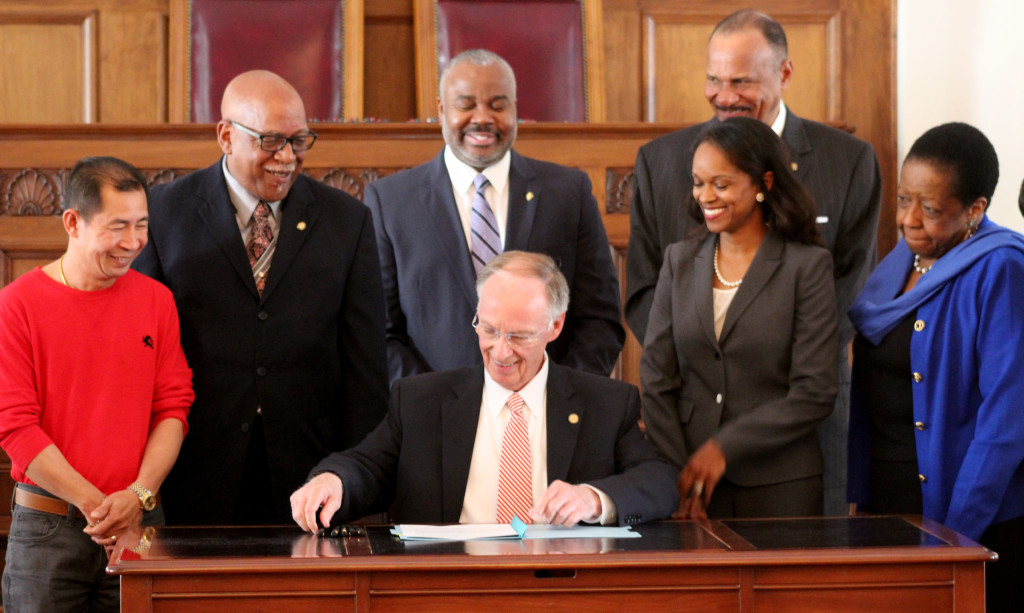
On Wednesday, Gov. Robert Bentley signed an Executive Order creating the Governor’s Office of Minority Affairs (GOMA). The newly formed office will look into issues facing women and minorities in the state. Specifically, the office will be tasked with: Conduct community outreach throughout the state to assess and address issues facing women and minorities Encourage public debate on issues affecting Alabama minority populations, including open access to public services and fair and equitable implementation of public policy Assess efforts by state agencies to assist women and minorities, promoting self-sufficiency through education and training Collaborate with business and industry representatives, the Alabama Workforce Council, higher education stakeholders and the Alabama Small Business Commission to facilitate identification of minority and women-owned businesses and to provide recommendations on how to better foster economic development opportunities for minority and women-owned businesses, with the goal of increasing the number of minority and women-owned businesses Advise the Governor concerning the coordination and administration of state programs serving minority populations Monitor existing legislation and programs designed to meet the needs of minorities Research and analyze all areas affecting the quality of life of minorities At the helm of the office will be Nichelle Nix, who noted during Wednesday’s press conference that it would be her goal to “ensure fairness and equality.” “I know we have a challenging road ahead of us,” Nix said. “I am resolute in my efforts to help the Governor… together we will lift every voice in the state of Alabama.” Most recently Nix has served as an attorney in the Governmental and Regulatory Affairs Division at Maynard, Cooper & Gale, P.C. in Birmingham. She studied Political Science at Spellman College in Atlanta and earned her Master’s Degree in Public Health from Emory University. During the press conference, Bentley praised Nix for being a “great person” with “great credentials” and a vast array of training and experience. While all of the details are not worked out for funding the office, Bentley noted that it will fall under the governor’s office and be funded from there. Further details will emerge as those involved have a better idea of how many people will be employed by the office. “Alabama has a unique history in promoting civil rights for minorities, and the courage and boldness of our citizens is a testament to the principles on which our state and country were founded,” Bentley said in a news release. “The newly created Governor’s Office of Minority Affairs will be a great resource and a new perspective on addressing minority and women’s issues. My goal is to make Alabama stronger, and minorities and women are an important component of the Great State 2019 Plan.”
Darryl Paulson: The zenith of Donald Trump
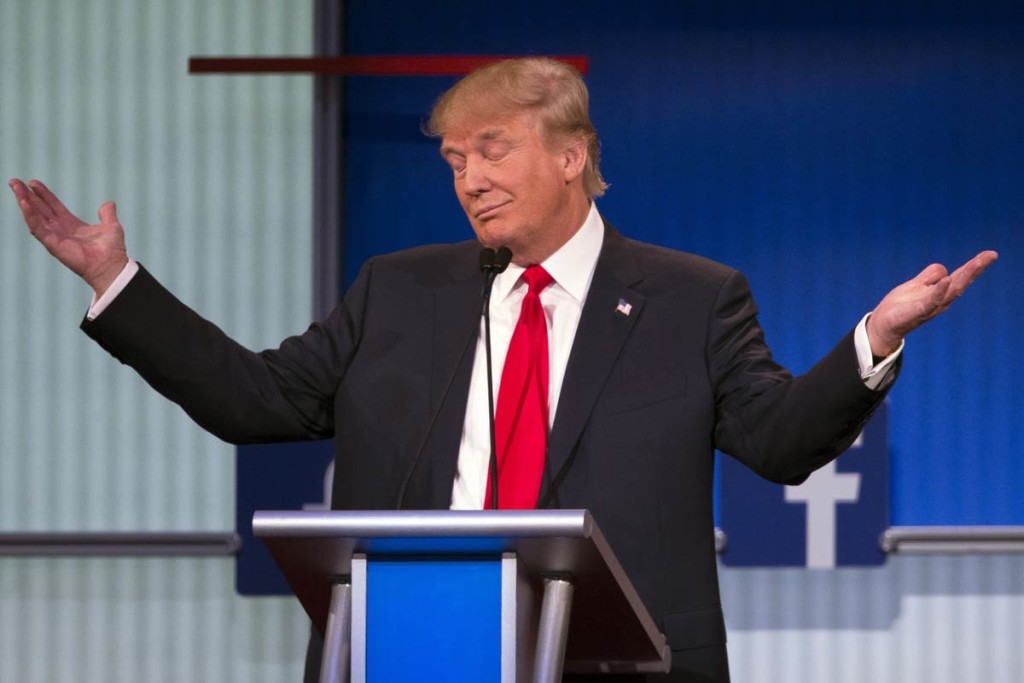
Here are two critical points concerning Donald Trump. First, he is barely a Republican. Second, he is certainly not a conservative. It is obvious that Trump is leading the field of 17 Republican candidates. His support in four recent polls all had Trump in first place, ranging from a low of 21 percent in the Bloomberg poll to 26 percent in both the Fox poll and the Monmouth University poll. That’s the good news for Trump. The bad news is that Trump may move up a few points, but he has reached the zenith of his support. A recent Economist/YouGov.com survey found that about a third of Americans had a favorable view of Trump and 58 percent had an unfavorable view. Trump will soon be taking the “down” elevator in public opinion polls. The same poll found that when the numbers were broken down by age, race, region, gender and income, Trump’s unfavorables were substantially higher in every category but one: voters 65 and older. His support among African-Americans, Hispanics and women is almost nonexistent. A Rasmussen Poll released Tuesday found strong evidence that the Trump decline may have already started. A survey of 651 likely Republican voters conducted between Sunday and Monday, found that support for Trump has declined from 24 percent to 17 percent in the past 10 days. Trump’s support among men has fallen from 30 percent to 19 percent, and support from women has dropped from 22 percent to 14 percent. Trump is at the top right now because he is perceived as the non-politician in the age where Americans of all political stripes hate the establishment. Voters are frustrated and alienated with politics and politicians, and Trump has successfully appealed to them. Trump’s supporters see him as the outsider who will shake-up the system, much like those who supported George Wallace and Ross Perot were viewed as political mavericks. Trump’s one major contribution to the presidential race us that he has demonstrated to the other candidates that the voters do not like them and their hollow promises one bit. Trump will falter for many reasons. As Larry Thornberry has written in The American Spectator, a leading conservative publication, Trump is “an arrogant, self-satisfied, crude and pompous windbag and bully who grossly overestimates his knowledge, his successes, and, not the least, his charm.” He attacks any critic as “stupid” or “loser,” but has a political glass jaw when he is criticized. Trump will lose because he is running as a Republican this year simply because he feels like it. He quit the party in 1999 saying that “Republicans are just too crazy right.” He then hired Roger Stone, who resigned as Trump’s campaign manager a few days ago, to consider a 2000 run as a Reform Party candidate. In 2009, Trump was back as a Republican. The next year he decided he was an independent and then in 2012, he was once again a Republican. His moving from one political party to another, all for political expediency, might remind Florida voters of Gov. Charlie Crist. Trump is the Bernie Sanders of the Republican Party. Both Trump and Sanders are running to lead a party that neither really calls home and that both have spent more time disparaging than uplifting it. During most of the first decade of the 21st century, the vast majority of the $1.5 million that Trump donated to political candidates went to Democrats, including contributions to Nancy Pelosi and $100,000 to the Clinton Foundation. When asked about his contributions to both Democrats and Republicans, Trump justified them by saying, “When you give, they do whatever you want them to.” I am sure that will appeal to Americans who hate politics for precisely that reason. Trump will lose because he is not a conservative in a party that is dominated by conservatives. In a 2000 book Trump called himself a “liberal” on health care. He supported a single-payer health plan that conservatives loathe, and he was once pro-choice, although he now says he is against abortion. A few years ago, Trump supported a 14.25 percent mega-tax on those making more than $10 million. Now he wants to cut income taxes in half. As Bruce Bartlett, former aide to U.S. Rep. Jack Kemp, said of Trump: “He is nothing if not inconsistent. He’s been on every side of every issue from every point of view as far as I can tell.” If you have not noticed, Trump is also delusional. He calls immigrants “rapists and murderers,” and then says he will win the Hispanic vote. He insults conservative icon Megyn Kelly for attacking him unfairly and having blood coming out her eyes and “whatever.” Trump also believes he will win the votes of women. Republicans, conservatives and Americans deserve better than Trump. “Donald, you’re fired!” Darryl Paulson is Professor Emeritus of Government at the University of South Florida St. Petersburg and resides in Palm Harbor.
Donald Trump: “I don’t recognize” insults of women
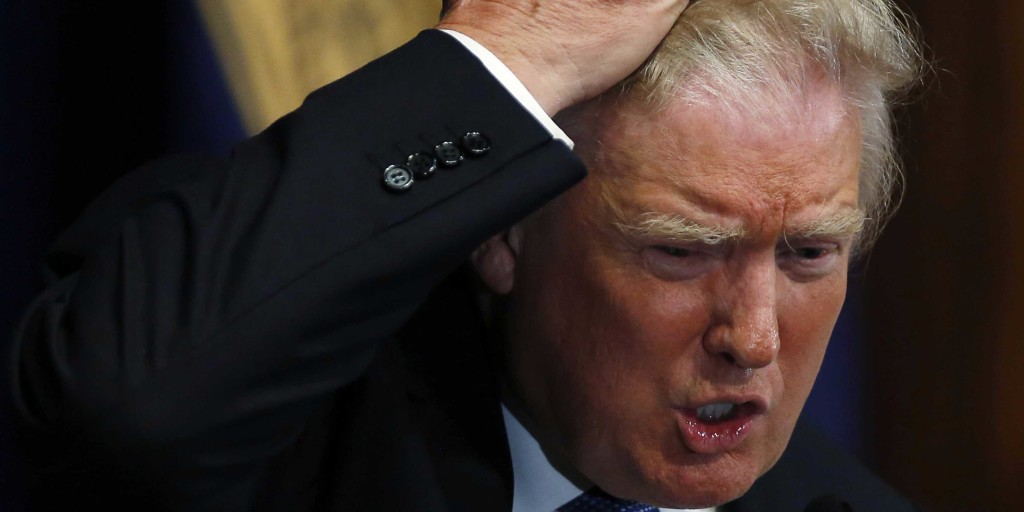
GOP presidential front-runner Donald Trump says he can’t recall specifics of insulting women, though news reports paint a long history of him comparing women to animals. Trump said Friday he doesn’t recognize the words Fox News‘s Megyn Kelly used during a debate on Thursday. Kelly asked about him having called women “fat pigs,” “dogs,” “slobs,” and “disgusting animals.” In the debate, Trump joked that he was only referring to talk show host Rosie O’Donnell but didn’t deny having used the insults. “I don’t frankly have time for total political correctness,” Trump said during the debate. The issue is important because women are a majority of registered voters. On Friday, Trump questioned whether he actually used those insults. “You know, some of the statements she made about the women, I don’t recognize those words whatsoever,” Trump said on ABC’s “Good Morning America.” “We’re going to take a very serious look at it.” He said on MSNBC‘s “Morning Joe,” “Not that I’m an angel, by the way. But I don’t recognize those words, so you know, she was spewing out these words, and I’m sitting there. … We’re going to have it checked out.” In fact, news outlets have reported on the incidents Kelly mentioned. Trump wrote New York Times columnist Gail Collins that she had the “face of a dog,” the columnist wrote in 2011. Trump called a lawyer “disgusting” when she wanted a break to pump milk for her baby, The New York Times reported last month. Trump has called O’Donnell a “fat pig,” a “slob” and an “animal,” according to several published reports. Kelly also mentioned that Trump had once told a contestant on NBC’s Celebrity Apprentice it would be a pretty picture to see her on her knees. Republished with permission of The Associated Press.
Census data shows great strides for women, but much more left to do
In the past four decades, there has been a number of changes in American society and culture. However, for women in the U.S., some things have stayed much the same, according to Census Bureau data released in advance of National Women’s History Month. National Women’s History Month began in March 1857, when women from New York City factories staged a protest over working conditions. International Women’s Day, first observed in 1909, led to Congress establishing National Women’s History Week, commemorated the second week of March. By 1987, Congress expanded the week-long celebration to a month, celebrated in March. As for women in today’s workforce, numbers show significant gains, while others show much work left to do. By way of sheer numbers, women’s participation in the labor force has increased considerably, from 30.3 million in 1970 to 75.1 million females 16 and older who participated in the civilian labor force in 2013. Women made up 37.97 percent of the 1970 labor force, jumping to 47.4 percent of the civilian labor force in 2013. Particular occupations have also seen a sharp increase in women workers. Census data had shown little participation from women in 1970 as accountants, police officers, lawyers and judges, physicians and surgeons, and pharmacists. By 2006-2010, women made considerable gains in those fields – with particularly strong presence as accountants (60 percent). Of the STEM (science, technology, engineering, and math) fields, 63 percent of social scientists are women, the heaviest representation of women among all. Among other STEM fields, about 14 percent of engineers, 45 percent of mathematicians and statisticians and 47 percent of life scientists were women. On the other hand, growth in certain segments of the workforce has slowed for women. The largest gain in women’s workforce participation occurred between 1970 and 1980, followed by a slowdown. An increase of only 0.4 percentage points occurred in the period leading up to 2006-2010. Compare that growth rate to a peak of 4.3 percentage points in the 1970s. Several occupations are overwhelmingly female. For example, women make up 96.3 percent of dental assistants, 95.9 percent of secretaries and 91.2 percent of registered nurses. Those standings have changed the least in the past 40 years. In 1970, secretaries, bookkeepers, and elementary school teachers were primarily women. In 2006-2010, those women-led occupations were secretaries and administrative assistants, cashiers, and elementary and middle schoolteachers. One explanation is the sheer numbers of jobs available; there are more jobs out there for elementary and middle school teaching positions than (as an example) surgeons. In comparison, the leading jobs for men remain the same as back in 1970: miscellaneous managers, truck drivers, and production supervisors. Four decades later, it is truck drivers, various managers, and freight, stock, and material movers. Researchers say the increase in female participation in the workplace started with the economics of the 1970s, beginning when a single-income household could no longer support a middle-class lifestyle. Gender wage gap remained a major issue in 2014; the Census found that year-round, full-time female workers earned 78¢ in 2013 for every dollar their male counterparts earned. Those numbers are not statistically different from 2012. [Source: U.S. Census Bureau]
Introducing: Alabama Today Women of Influence

As the U.S. Census celebrates March as National Women’s Month, Alabama Today proudly kicks off its “Women of Influence” series. The weekly column will spotlight the women of Alabama who are impacting communities, strengthening families and leading businesses. National Women’s History Month began in 1857, when women from New York City factories staged a protest over working conditions. International Women’s Day, first observed in 1909, led to Congress establishing National Women’s History Week, commemorated the second week of March. By 1987, Congress expanded the week-long celebration to a month. Every year, Congress passes a resolution to honor Women’s History Month, with a proclamation issued by the President. As of December 2013, there are 161 million females in the U.S., compared to 156.1 million males. More than 75.1 million women ages 16 and older participate in the civilian workforce. According to Census estimates, the top four occupations with a majority of women — 80 percent or more are registered nurses; social workers; licensed practical and vocational nurses; and bookkeeping, accounting and auditing clerks. Readers are encouraged to nominate women of influence from around Alabama who are active in business, politics, philanthropy and more at tips@altoday.com.
