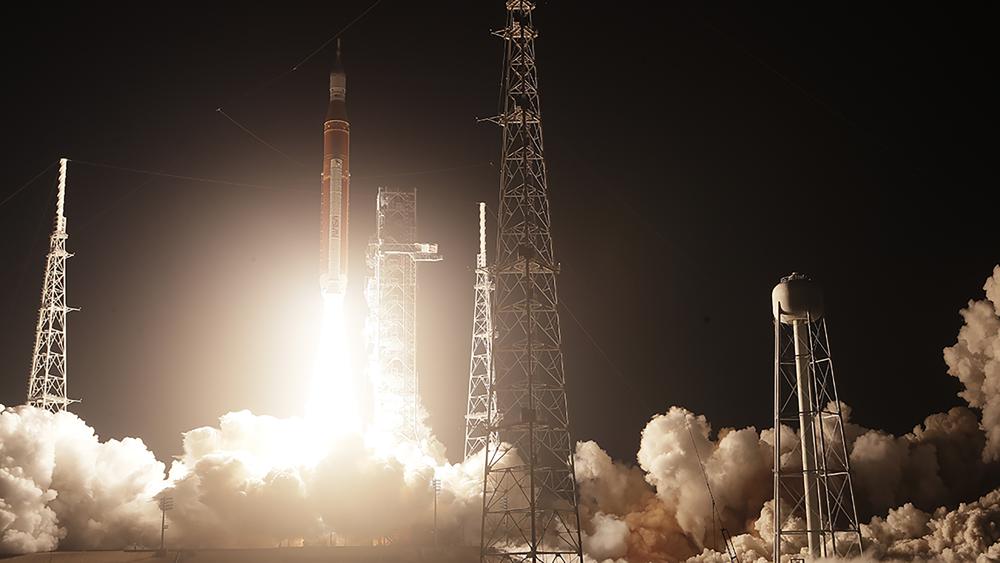
Early on Wednesday morning, the Space Launch System (SLS) launched from the Kennedy Space Center in Cape Canaveral, Florida. Onboard was the Orion spacecraft which the SLS launched into space on its way to the Moon. The Artemis I mission is unmanned, but is an essential precursor to man’s return to the Moon after almost a fifty-year absence.
The Artemis I mission is the first integrated flight test of the agency’s deep space exploration systems. The SLS is the most powerful rocket in the world and has been engineered and tested at the Marshall Space Flight Center in Huntsville. The launch into space is just the first leg of the mission. Orion is planned to travel approximately 40,000 miles beyond the Moon and return to Earth over the course of 25.5 days. The mission is a critical part of NASA’s Moon to Mars exploration approach.
“What an incredible sight to see NASA’s Space Launch System rocket and Orion spacecraft launch together for the first time,” said NASA Administrator Bill Nelson in a statement. “This uncrewed flight test will push Orion to the limits in the rigors of deep space, helping us prepare for human exploration on the Moon and, ultimately, Mars.”
We are going.
— NASA (@NASA) November 16, 2022
For the first time, the @NASA_SLS rocket and @NASA_Orion fly together. #Artemis I begins a new chapter in human lunar exploration. pic.twitter.com/vmC64Qgft9
After reaching its initial orbit, Orion deployed its solar arrays, and engineers began performing checkouts of the spacecraft’s systems. After one and a half hours of flight, the rocket’s upper stage engine successfully fired for approximately 18 minutes, launching Orion out of Earth orbit and on to its flight to the Moon.
Orion has successfully separated from its upper stage and is now powered by its service module, which was provided by the European Space Agency (ESA).
“It’s taken a lot to get here, but Orion is now on its way to the Moon,” said Jim Free, NASA deputy associate administrator for the Exploration Systems Development Mission Directorate. “This successful launch means NASA and our partners are on a path to explore farther in space than ever before for the benefit of humanity.”
Artemis is more than just a test of the spacecraft; it is also performing science missions of its own. Onboard is a series of 10 small science investigations and technology demonstrations called CubeSats. The CubeSats will deploy from a ring that connected the upper stage to the spacecraft. Each CubeSat has its own mission that has the potential to fill gaps in our knowledge of the solar system or demonstrate technologies that may benefit the design of future missions to explore the Moon and beyond.
Orion’s service module will need to perform the first of a series of burns to keep Orion on course toward the Moon. In the coming days, mission controllers at NASA’s Johnson Space Center in Houston will conduct additional checkouts and course corrections as needed. Orion is expected to fly by the Moon on November 21, performing a close approach of the lunar surface on its way to a distant retrograde orbit, a highly stable orbit thousands of miles beyond the Moon.
“The Space Launch System rocket delivered the power and performance to send Orion on its way to the Moon,” said Mike Sarafin, Artemis I mission manager. “With the accomplishment of the first major milestone of the mission, Orion will now embark on the next phase to test its systems and prepare for future missions with astronauts.”
The Artemis I mission was delayed by a fuel line leak in the SLS, a faulty temperature sensor, and then by Hurricanes Ian and Nicole. Following Hurricane Nicole, NASA teams conducted thorough assessments of the rocket, spacecraft, and associated ground systems and confirmed there were no significant impacts from the severe weather.
Engineers repaired the leak and demonstrated updated tanking procedures. Teams also performed standard maintenance to repair minor damage to the foam and cork on the thermal protection system and recharged or replaced batteries throughout the system.
If all goes well, the manned Artemis mission is planned for 2024. NASA intends to create a permanently manned presence on the moon, tentatively scheduled for 2028.
The Artemis I is supported by thousands of people around the world, including many in Alabama.
To connect with the author of this story, or to comment, email brandonmreporter@gmail.com.
Related
Share via: