
Robert Aderholt expresses excitement over the successful Artemis 1 Launch

On Wednesday, Congressman Robert Aderholt released a statement following the successful Artemis I launch at Cape Canaveral, Florida, earlier on Wednesday morning. “I am beyond excited that Artemis I has taken to the sky,” Aderholt said. “This historic moment marks the beginning of a new era of human presence and permanence in space with the United States at the helm. I am sending my sincerest congratulations to the Artemis team, NASA, and everyone involved, especially our incredible workforce here in Alabama, in making this extraordinary feat possible.” On Twitter, Aderholt wrote, “Congratulations to everyone involved in the successful launch of @NASAArtemis. I particularly want to thank everyone @NASA_Marshall. This historic moment marks the beginning of a new era of human presence and permanence in space.” Artemis I is the first of several missions by NASA to send astronauts back to the Moon. The uncrewed mission will test the capabilities of the NASA Space Launch System and Lockheed Martin’s Orion capsule in delivering astronauts to lunar orbit. The Orion spacecraft will travel a total of 1.3 million miles around and past the Moon before its return to Earth on December 11, 2022. During Artemis I, the Orion spacecraft will journey 40,000 miles beyond the Moon before returning to Earth. Orion is equipped with cameras to collect valuable engineering data and show new perspectives of the Moon and the journey. There are 24 cameras on the spacecraft. Eight were on the SLS, and 16 are on Orion. The cameras document the liftoff, ascent, solar array deployment, external rocket inspections, landing and recovery, and capture images of Earth and the Moon. “Each of Orion’s four solar array wings has a commercial off-the-shelf camera mounted at the tip that has been highly modified for use in space, providing a view of the spacecraft exterior,” said David Melendrez, imagery integration lead for the Orion Program at NASA’s Johnson Space Center in Houston. The arrays can adjust their position relative to the rest of the spacecraft to optimize the collection of sunlight which is used to power Orion. This also allows the Mission Control Center flight controllers at NASA’s Johnson Space Flight Center to point the cameras at different parts of the spacecraft for inspections and to document the mission. If the Artemis I mission is successful, NASA hopes to launch a manned mission as early as 2024. NASA has plans for a permanent manned presence on the Moon, perhaps as early as 2028. The return to the Moon after 50 years of absence is being used to develop systems and processes for a manned mission to Mars slated for 2035. Thousands of Alabamians have worked on the SLS and Artemis missions through both NASA’s Marshall Space Flight Center in Huntsville as well as at NASA’s many contractors. Aderholt presently serves as the Ranking Member on the Appropriations Subcommittee on Commerce, Justice, and Science that funds NASA through the annual federal budget. Since Republicans gained control of the House in the recent midterm elections, Aderholt is likely to chair that subcommittee or even Appropriations as a whole – since the party that controls the House selects the Chairs of all the Committees. Aderholt was recently elected to his fourteenth term representing Alabama’s Fourth Congressional District. To connect with the author of this story, or to comment, email brandonmreporter@gmail.com.
NASA’s Artemis mission is underway
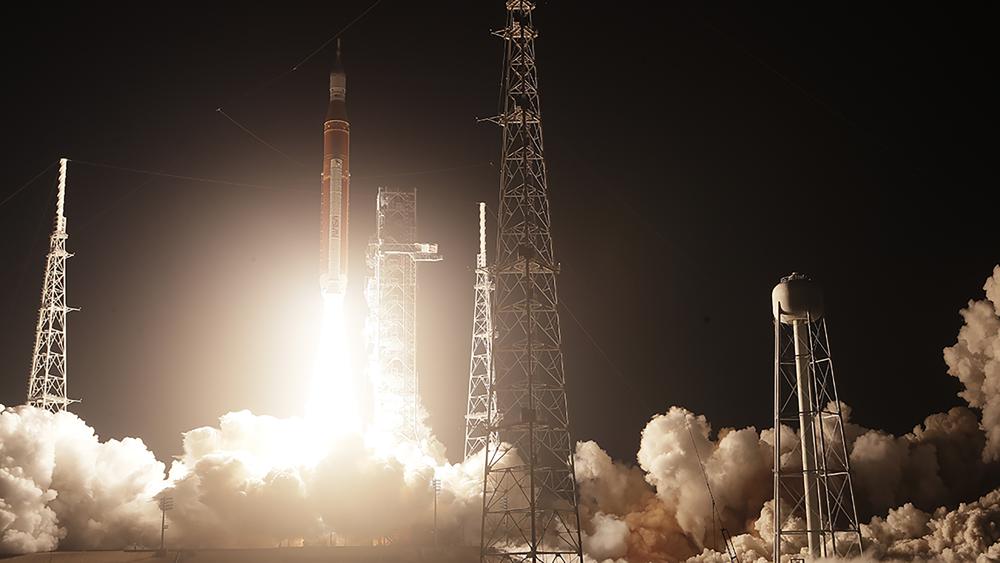
Early on Wednesday morning, the Space Launch System (SLS) launched from the Kennedy Space Center in Cape Canaveral, Florida. Onboard was the Orion spacecraft which the SLS launched into space on its way to the Moon. The Artemis I mission is unmanned, but is an essential precursor to man’s return to the Moon after almost a fifty-year absence. The Artemis I mission is the first integrated flight test of the agency’s deep space exploration systems. The SLS is the most powerful rocket in the world and has been engineered and tested at the Marshall Space Flight Center in Huntsville. The launch into space is just the first leg of the mission. Orion is planned to travel approximately 40,000 miles beyond the Moon and return to Earth over the course of 25.5 days. The mission is a critical part of NASA’s Moon to Mars exploration approach. “What an incredible sight to see NASA’s Space Launch System rocket and Orion spacecraft launch together for the first time,” said NASA Administrator Bill Nelson in a statement. “This uncrewed flight test will push Orion to the limits in the rigors of deep space, helping us prepare for human exploration on the Moon and, ultimately, Mars.” After reaching its initial orbit, Orion deployed its solar arrays, and engineers began performing checkouts of the spacecraft’s systems. After one and a half hours of flight, the rocket’s upper stage engine successfully fired for approximately 18 minutes, launching Orion out of Earth orbit and on to its flight to the Moon. Orion has successfully separated from its upper stage and is now powered by its service module, which was provided by the European Space Agency (ESA). “It’s taken a lot to get here, but Orion is now on its way to the Moon,” said Jim Free, NASA deputy associate administrator for the Exploration Systems Development Mission Directorate. “This successful launch means NASA and our partners are on a path to explore farther in space than ever before for the benefit of humanity.” Artemis is more than just a test of the spacecraft; it is also performing science missions of its own. Onboard is a series of 10 small science investigations and technology demonstrations called CubeSats. The CubeSats will deploy from a ring that connected the upper stage to the spacecraft. Each CubeSat has its own mission that has the potential to fill gaps in our knowledge of the solar system or demonstrate technologies that may benefit the design of future missions to explore the Moon and beyond. Orion’s service module will need to perform the first of a series of burns to keep Orion on course toward the Moon. In the coming days, mission controllers at NASA’s Johnson Space Center in Houston will conduct additional checkouts and course corrections as needed. Orion is expected to fly by the Moon on November 21, performing a close approach of the lunar surface on its way to a distant retrograde orbit, a highly stable orbit thousands of miles beyond the Moon. “The Space Launch System rocket delivered the power and performance to send Orion on its way to the Moon,” said Mike Sarafin, Artemis I mission manager. “With the accomplishment of the first major milestone of the mission, Orion will now embark on the next phase to test its systems and prepare for future missions with astronauts.” The Artemis I mission was delayed by a fuel line leak in the SLS, a faulty temperature sensor, and then by Hurricanes Ian and Nicole. Following Hurricane Nicole, NASA teams conducted thorough assessments of the rocket, spacecraft, and associated ground systems and confirmed there were no significant impacts from the severe weather. Engineers repaired the leak and demonstrated updated tanking procedures. Teams also performed standard maintenance to repair minor damage to the foam and cork on the thermal protection system and recharged or replaced batteries throughout the system. If all goes well, the manned Artemis mission is planned for 2024. NASA intends to create a permanently manned presence on the moon, tentatively scheduled for 2028. The Artemis I is supported by thousands of people around the world, including many in Alabama. To connect with the author of this story, or to comment, email brandonmreporter@gmail.com.
Artemis 1 launch scrubbed after engine issues
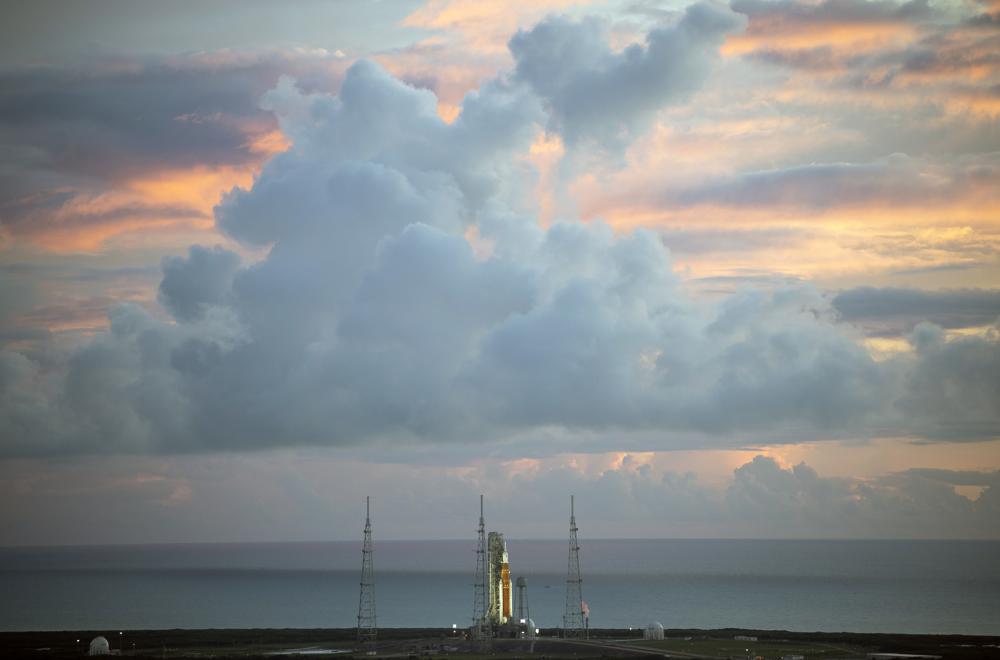
The Space Launch System (SLS) was supposed to have launched today at 7:30 a.m. for the Artemis I mission, but a problem loading the fuel led to NASA Launch Director Charlie Black Thompson giving the order to scrub the mission at 7:35 after engineers were unable to figure out how to fix the problem. NASA explained that the supercooled liquid hydrogen that powers the RS-25 engine is extremely light and is kept at minus-423 degrees Fahrenheit, which makes it a difficult propellant to control. NASA conditions the engines by bleeding liquid hydrogen through them approximately an hour before ignition. The bleed line for engine number three failed. While liquid oxygen loading into the interim cryogenic propulsion stage continued and core stage tanks continued to be replenished with propellants, engineers attempted to troubleshoot the unexpected issue with engine number three. Without the bleed line functioning, the correct temperature of the fuel was not kept. Countdown was halted 40 minutes before launch. After engineers failed to diagnose and fix the problem in time to stay within the two-hour launch window, Thompson ordered the mission scrubbed. The next launch window is Friday at 11:30 a.m. CDT. Being able to launch then will depend on whether or not NASA engineers can fix the problem in order to safely launch the SLS. This is a problem that NASA calls cryopumping. NASA has experience with this issue as it periodically delayed space shuttle missions as well. While the SLS is fully fueled, engineers are gathering data on engine number three in an attempt to understand and resolve the issue. “We don’t launch if it is not right,” said NASA Administrator Bill Nelson. “It is illustrative that this is a complicated machine, and it is a very complicated system.” Nelson said that sometimes missions have to be scrubbed. “It is just part of the space business, and it is particularly part of a test flight,” Nelson said. Vice President Kamala Harris was on hand for the anticipated launch. “She is fully briefed on the whole thing,” Nelson said. “She is a very enthusiastic space flight booster, as is President (Joe) Biden.” Artemis I was not a crewed mission. It was the first test of the SLS and the Orion spacecraft, which is designed to carry astronauts. The Artemis missions, NASA hopes, will take American astronauts back to the moon. This was the first attempt to launch the multibillion-dollar rocket paired with the Orion module. Boeing is the prime contractor for the project, which has cost $23 billion to this point. The goal of the Artemis program is to create a sustainable human presence on and in a space station, Gateway, that will orbit the moon. Artemis I will launch the Orion capsule to the Moon. It is expected to spend 42 days in space and orbit the Moon before returning to Earth. It will take six days just to reach the Moon. Artemis II will be crewed and will carry as many as four astronauts into lunar orbit. Artemis III is expected to land on the Moon as early as 2025. It is too early to tell if today’s issue that led to the launch being scrubbed will further delay future Artemis missions. The SLS has been designed and engineered at Marshall Space Flight Center in Huntsville. To connect with the author of this story, or to comment, email brandonmreporter@gmail.com.
