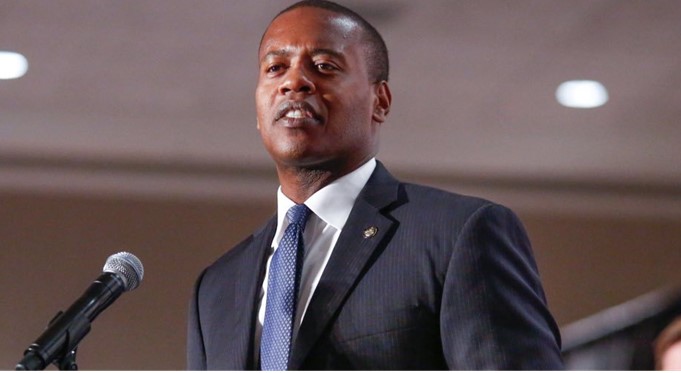
State Representative Anthony Daniels (D-Huntsville), Minority Leader of the Alabama House of Representatives, released a statement on the landmark Supreme Court decision in Students for Fair Admissions Inc. v. President and Fellows of Harvard College. Daniels said he was concerned that the decision threatened to overturn decades of progress in the country.
“We are an increasingly diverse country that is still grappling with a legacy of racism and the resultant and ongoing disparities based upon race,” said Leader Daniels. “Rather than encourage solutions to address those disparities, the Court today deepened them. It also widened existing and growing political divisions.”
“Today’s Supreme Court ruling pretends these racial disparities don’t exist, despite overwhelming evidence that shows they impact test scores, student achievement, and access to educational and economic opportunity for so many individuals and families,” Daniels continued. “The irony is that at least two members of the majority are the direct beneficiaries of affirmative action and related policies.” Daniels continued. “Justice [Amy] Coney Barrett attended a law school with gender balance, and Justice [Clarence] Thomas benefitted from Yale’s affirmative action program. The fact that they benefited from these or related policies to put them on the path to career success (and the highest court in the land) but now want to erect a roadblock for others is not only disappointing, but it’s also downright wrong.”
Daniels continued, “We desperately wish they could connect their individual stories of advancement to the promises that our Constitution is supposed to uphold for all. Simply put: your success story is not only a matter of where you came from. It’s also a matter of how you got there. This decision is deeply disappointing and terribly cynical. It threatens to roll back decades of progress in our educational institutions and our society. Sadly, it also reveals what some of us have long known – many qualified and privileged Americans either can’t or won’t recognize the opportunities afforded to them along the way.”
“Furthermore, the majority opinion actually reveals that arguments for Affirmative Action must have some merit as it exempts military academies from the ban that it’s unilaterally applying to the rest of America,” said Daniels. “In the words of Justice Ketanji Brown Jackson, “The Court has come to rest on the bottom-line conclusion that racial diversity in higher education is only worth potentially preserving insofar as it might be needed to prepare Black Americans and other underrepresented minorities for success in the bunker, not the boardroom (a particularly awkward place to land, in light of the history the majority opts to ignore).”
“Race is a fact of life in America,” concluded Daniels. “Again, as Justice Brown Jackson wrote, “Deeming race irrelevant in law does not make it so in life.” This decision means that educational institutions will now have to work harder to reflect the diversity of our country and the unifying values of equality and fairness that can never be taken for granted. And it’s up to us to help them do it.”
Harvard Dean David N. Hempton responded to the news the Supreme Court had found against their admissions policy.
Hempton wrote, “Today, the Supreme Court delivered its decision in Students for Fair Admissions v. President and Fellows of Harvard College. The Court held that Harvard College’s admissions system does not comply with the principles of the equal protection clause embodied in Title VI of the Civil Rights Act. The Court also ruled that colleges and universities may consider in admissions decisions “an applicant’s discussion of how race affected his or her life, be it through discrimination, inspiration, or otherwise.” We will certainly comply with the Court’s decision.”
“Harvard must always be a place of opportunity, a place whose doors remain open to those to whom they had long been closed, a place where many will have the chance to live dreams their parents or grandparents could not have dreamed,” Hempton said. “For almost a decade, Harvard has vigorously defended an admissions system that, as two federal courts ruled, fully complied with longstanding precedent. In the weeks and months ahead, drawing on the talent and expertise of our Harvard community, we will determine how to preserve, consistent with the Court’s new precedent, our essential values.”
“Harvard must always be a place of opportunity, a place whose doors remain open to those to whom they had long been closed, a place where many will have the chance to live dreams their parents or grandparents could not have dreamed,” Hempton stated. “For almost a decade, Harvard has vigorously defended an admissions system that, as two federal courts ruled, fully complied with longstanding precedent. In the weeks and months ahead, drawing on the talent and expertise of our Harvard community, we will determine how to preserve, consistent with the Court’s new precedent, our essential values.”
Colleges and universities across this country will have to review their admissions policies to ensure that they comply with this ruling and are not discriminating on the basis of race.
To connect with the author of this story or to comment, email brandonmreporter@gmail.com.
Related
Share via: