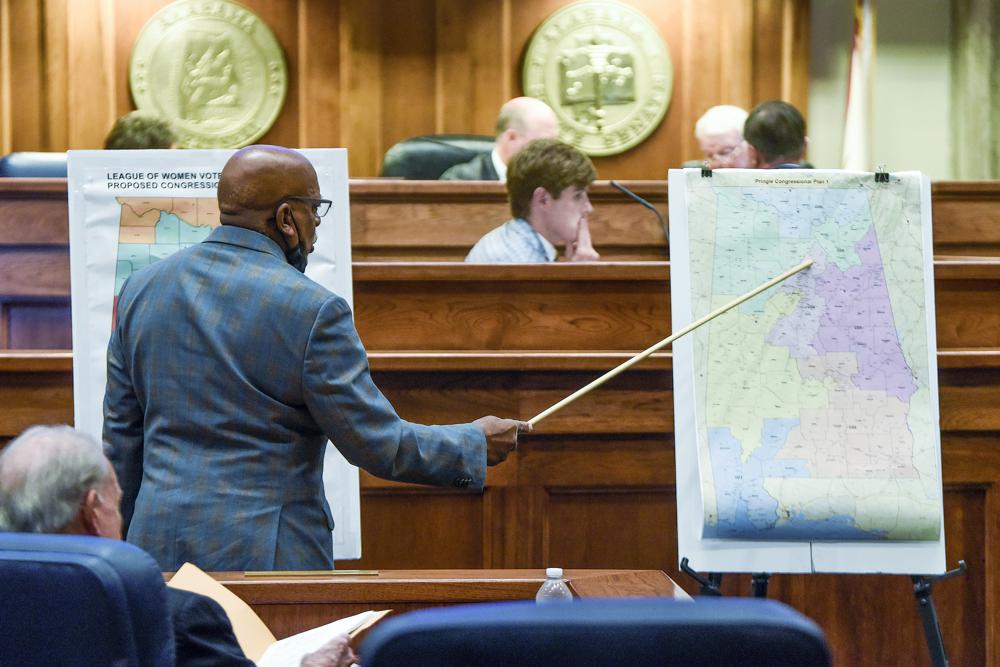
On Wednesday, the Alabama House of Representatives passed a controversial congressional redistricting plan along party lines that failed to create a second majority-minority district. Hours later, the Alabama Senate passed a similar plan that also failed to turn Alabama’s Second Congressional District into a majority-minority district.
Civil rights groups are demanding that the Alabama Legislature create a second majority-minority district after the three-judge panel of the Eleventh Circuit Court of Appeals declared Alabama’s 2021 Congressional rezoning in violation of the Voting Rights Act of 1965. After initially staying the decision, the U.S. Supreme Court agreed that the Legislature’s 2021 plan denied Black Alabamians (27% of the population the ability to choose their own congressional representation). The court has ordered the state to present a new redistricting map by July 21.
The National Redistricting Foundation (NRF) accused the Legislature of defying the court order by not preparing a plan with two majority-minority districts. The NRF is the 501(c)(3) affiliate of the National Democratic Redistricting Committee (NDRC),
Marina Jenkins is the Executive Director of the NRF.
“The maps passed by the Alabama House and Senate are in flagrant disregard of the Alabama district court’s order to enact a map with two districts in which Black Alabamians can elect a candidate of their choice, and the Supreme Court’s decision affirming the lower court,” said Executive Director Jenkins in a statement. “This shameful process, riddled with partisan schemes deployed at the expense of Black voters’ rights, has failed the voters of Alabama who deserve a fair and compliant congressional map. Time and time again, Republican legislators have shown their intentions lie solely in maintaining their own political power and silencing the constituents they are meant to represent. Neither the House nor Senate map meet the requirement of the court’s order, or the law, and will be challenged.”
The plaintiffs in Milligan v. Allen that challenged the 2021 redistricting presented two maps to the court showing either two 51% Black districts or two districts that were 48% Black. The NRF has endorsed a heavily gerrymandered (along racial lines) plan that results in a 52.2% Black Second Congressional District and a 56.7% Black Seventh Congressional District.
The NRF-supported plan achieved that by dividing Mobile County into a majority-Black section that would be in the new majority-minority district that would stretch from the Mississippi to Georgia state lines and an overwhelmingly White portion that would then be in the First Congressional District with nearby Baldwin County (which is overwhelmingly White and Republican). It similarly divides Jefferson and Tuscaloosa Counties along racial lines. The Seventh Congressional District is already a majority-minority district represented since 2011 by Rep. Terri Sewell – a Black Democrat. That plan also puts Congressman Jerry Carl (R-AL01) and Congressman Barry Moore (R-AL02) into the same district – the First.
The Republicans in the Alabama Legislature have rejected any plan that divides Mobile County or splits Baldwin and Mobile into separate congressional districts. They argue that the Alabama Gulf Coast and the Wiregrass regions should not be divided.
The Republican Legislators call their plan the Communities of Interest Plan. The House passed a version of that plan that keeps Mobile and Baldwin whole and in the First Congressional District but increases the number of Black voters in the Second Congressional District to 42.5%. The Seventh Congressional District would be 52.15% Black.
The Legislative Committee on Reapportionment is chaired by State Rep. Chris Pringle – a Mobile Republican – and State Sen. Steve Livingston – a North Alabama Republican.
Pringle sponsored the plan that the House of Representatives passed, while Livingston sponsored the plan that the Senate passed.
Pringle insisted that even though there are more Whites than Blacks in his plan’s Second Congressional District, it would be a toss-up district that either party could win. Black legislators insisted that the only way a Black person could win a congressional race in Alabama is if the district is majority Black.
In the Senate plan, the Second Congressional District would become 38.8% Black, and the Seventh Congressional District would remain majority Black.
If either of the Republican plans passes the Legislature on Friday as drawn today, the plaintiffs are almost certain to reject that plan and ask the three-judge panel in Atlanta to reject the Alabama GOP plan and appoint a special master to draw the districts.
To connect with the author of this story or to comment, email brandonmreporter@gmail.com.
Related
Share via: