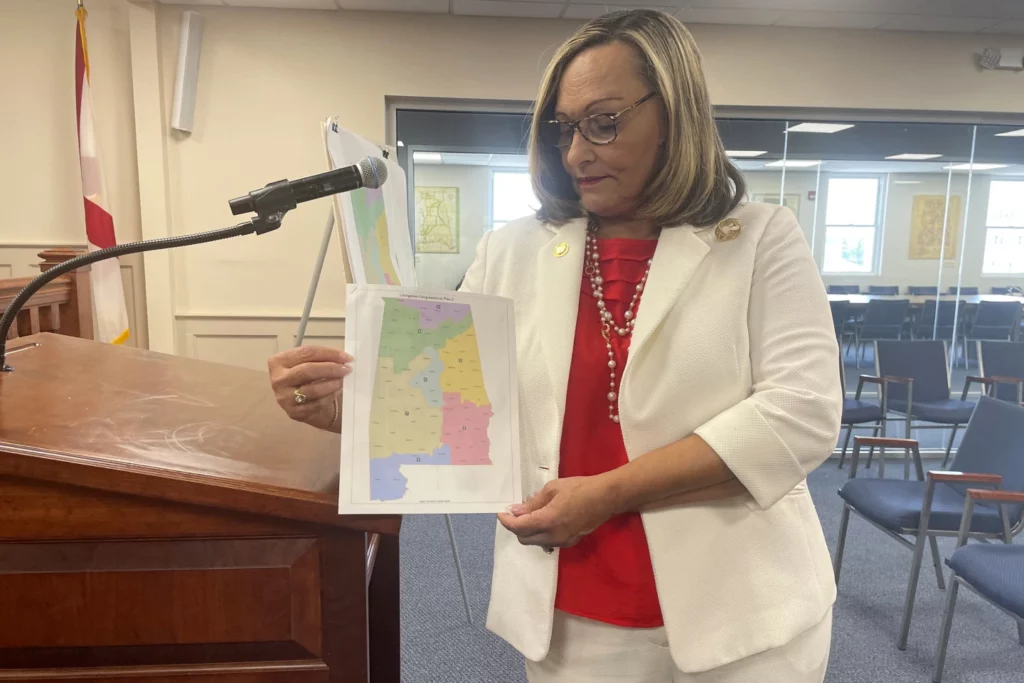
The Alabama Legislature passed a Republican congressional redistricting plan on Friday, setting up a battle in federal court that could either result in a federal court drawing Alabama’s congressional districts map or the most serious court challenge to the controversial Section 2 of the Voting Rights Act of 1965 in decades.
In June, the U.S. Supreme Court ruled that the redistricting plan passed by the Legislature in 2021 likely violated the Voting Rights Act of 1965. A three-judge panel in Atlanta ordered the state to draw a map with two majority Black congressional districts “or something close to it.”
The Legislature entered Friday with two Republican maps. One map increased Alabama’s Second Congressional District from 30% Black to over 42% Black. That plan was sponsored by State Representative Chris Pringle (D-Mobile). The other plan was sponsored by State Senator Steve Livingston (R-Scottsboro). The Livingston plan only increased the number of Black voters in CD2 from 30% to 38%. The House passed the Pringle plan while the Senate debated the Livingston plan.
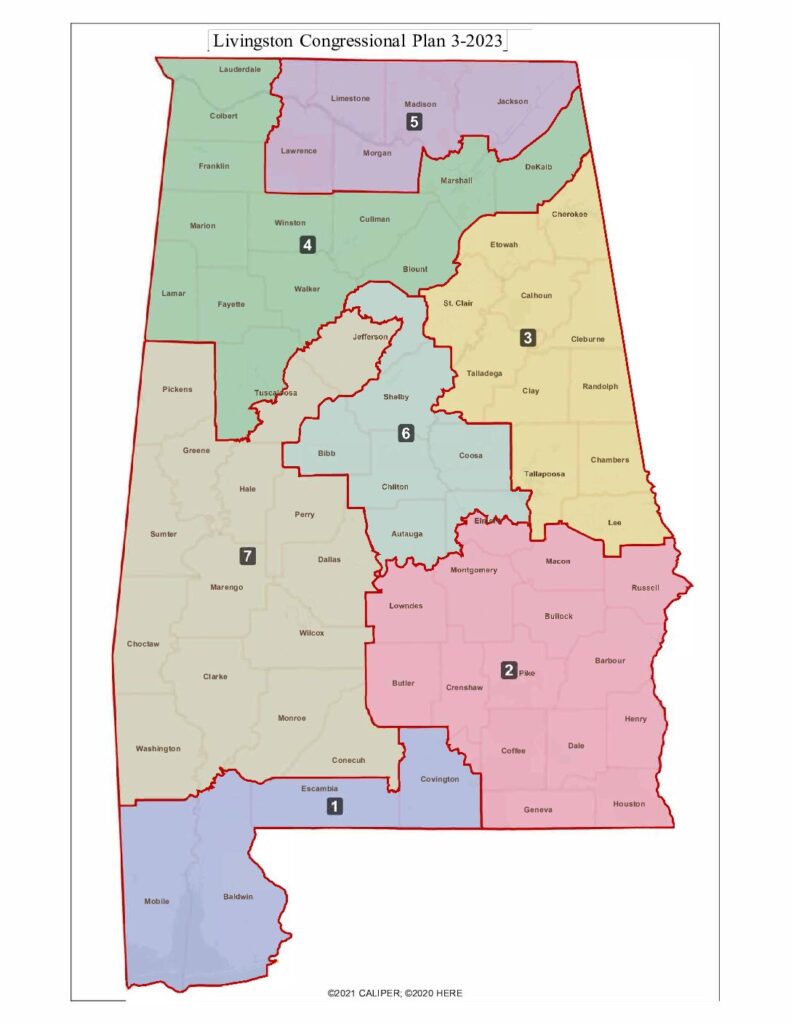
After the Senate voted to nonconcur with the Pringle plan, six legislators went into a six-member conference committee, and the four Republicans on the committee submitted a third plan. This map had previously been unseen by the press, the public, Democratic legislators, and presumably most Republican legislators. Both Houses of the Legislature then voted to adopt the conference committee plan.
The conference committee map leaves the Seventh Congressional District as the state’s only majority Black congressional district. It did increase the percentage of Black voters in CD2 from 30% to 39.9%. CD2 is currently represented by Freedom Caucus Republican Barry Moore (R-Enterprise). Moore staffers were in the Statehouse on Frida meeting with legislators.
Plaintiffs in the lawsuit have vowed to reject the Republican plan and adopt one of the Democratic plans that create two majority-minority districts or appoint a special master to draw Alabama’s congressional maps.
Alabama Governor Kay Ivey released a statement saluting the Legislature for their hard work and bold stance.
“Following the U.S. Supreme Court order, I called the Alabama Legislature into a special session to readdress our congressional map,” said Gov. Ivey. “The Legislature knows our state, our people, and our districts better than the federal courts or activist groups, and I am pleased that they answered the call, remained focused, and produced new districts ahead of the court deadline.”
The Alabama House Democratic Caucus (AHDC) was not pleased with the plan that passed without Democratic support.
“Once again, the Republican majority in Alabama is putting political ambition ahead of what is right and just,” the AHDC wrote. “And again, unfortunately, partisan politics is coming before Democratic rights, despite a decision upheld by the highest court in the land.”
“The court ruled that our Black population is large enough and geographically compact enough to create a second district,” the AHDC continued. “And yet, the majority pushed through a map that blatantly fails to meet that standard.”
“The House Democratic Caucus endorsed a map, supported by the plaintiffs, that satisfies that court’s ruling,” the AHDC added. “That majority has repeatedly ignored that option in an attempt to sidestep their duty to draw maps that represent all Alabama voters fairly and equitably.”
Congresswoman Terri Sewell (D-AL07) released a statement expressing disappointment with the Legislature’s work.
“Today, the State of Alabama has shamelessly chosen to ignore the Supreme Court,” Rep. Sewell said. “The map advanced by the state legislature includes only one majority-minority district and a second district where Black voters make up only 39.9 percent of the voting age population.”
“This map does not comply with the Supreme Court’s order and is an insult to Black voters across our state,” Sewell added. “I fully expect that it will be rejected by the courts.”
The Legislature has met the July 21 deadline set by the federal court in Atlanta. A hearing on Alabama’s congressional redistricting is scheduled for August. There is wide speculation that whatever happens in Atlanta with this redistricting, the loser will appeal to the U.S. Supreme Court. There is no guarantee that the Supreme Court will accept the case.
To connect with the author of this story or to comment, email brandonmreporter@gmail.com