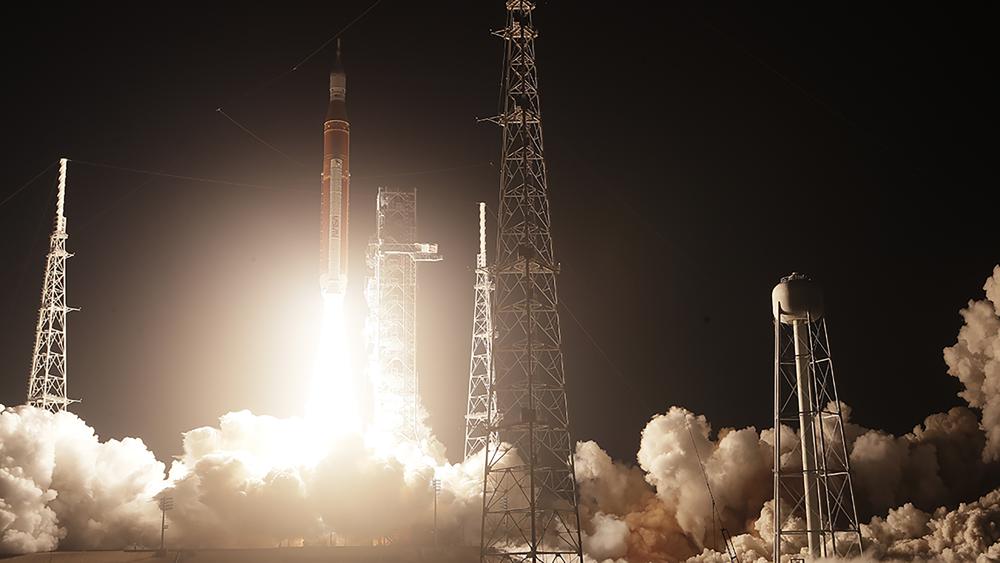
On Tuesday, United Launch Alliance (ULA) announced that it had postponed the launch of an important military mission due to approaching Hurricane Idalia, which hit the Florida coast as a CAT II Hurricane overnight.
ULA released a statement: “The launch of the United Launch Alliance Atlas V SILENTBARKER/NROL-107 mission for the National Reconnaissance Office (NRO) and the United States Space Force has been delayed due to the impending tropical storm. Out of an abundance of caution for personnel safety, a critical national security payload, and the approaching Tropical Storm Idalia, the team made the decision to return the rocket and payload to the vertical integration facility (VIF). We will work with our customers and the range to confirm our next launch attempt and a new date will be provided once it is safe to launch.”
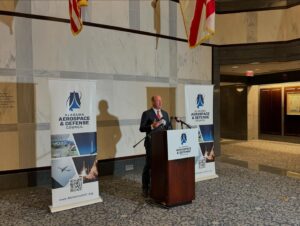
NRO, United Launch Alliance, and Space Systems Command (SSC) hosted a pre-launch press conference with journalists and Partners in Space.
NRO Director Dr. Christopher Scolese, Space Force Lt. Gen. Michael Guetlein, and ULA CEO Tory Bruno discussed the importance of SILENTBARKER/#NROL107, underscoring the element of partnership in this joint mission just hours before the mission was scrubbed due to the rapidly worsening weather forecast.
The U.S. Space Force and the NRO have numerous satellites in geosynchronous orbit, and the SILENTBARKER mission poised for liftoff will help track potential threats to those multibillion-dollar assets.
“Geosynchronous orbit is far away,” Scolese said. “Ground-based systems have a harder time seeing what’s up there. This provides us the capability of being in this same orbit so that we’re closer to what’s happening up there. It will not be looking at the ground; it will be looking at space.”
“The idea of the mission is to put a satellite into geosynchronous orbit and then to be looking at that orbital regime and get a sense of what’s happening day to day,” Scolese said. “Satellites do move in geosynchronous orbit. You’ve heard about communications satellites moving from one location to another to provide better coverage to other areas.”
This has been a very busy week for the team at ULA.
Their first Vulcan rocket is now atop its Cape Canaveral launch pad for the next phase of qualification testing in preparation for the inaugural flight.
Vulcan represents the next generation of rocket technology for the company, which builds its rockets at its rocket assembly plant in Decatur. ULA is a jointly owned venture between Boeing and Lockheed.
To connect with the author of this story or to comment, email brandonmreporter@gmail.com.
Related
Share via: