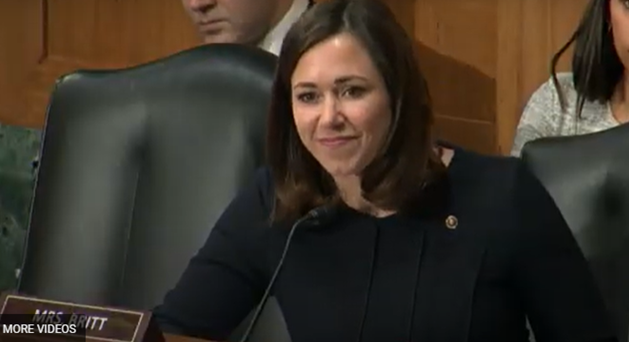
On Tuesday, U.S. Senator Katie Britt (R-Alabama) warned about what she believes would be the harmful effects of implementing the Basel III Endgame proposed rule recently issued jointly by the Board of Governors of the Federal Reserve System, the Federal Deposit Insurance Corporation, and the Office of the Comptroller of the Currency.
The “Basel III endgame” is a proposal for stricter bank capital requirements aimed at ensuring the stability of big banks. Proponents believe that the proposal would modify large bank capital requirements to better reflect underlying risks and increase the consistency of how banks measure their risks. The changes would implement the final components of the Basel III agreement. The proposal would apply to banks with $100 billion in assets or more and to smaller firms with “significant” trading activities.
Sen. Britt made her remarks as a participant in a Senate Banking, Housing, and Urban Affairs Committee hearing that featured testimony from the heads of four federal regulators with respective jurisdictions spanning the financial sector. The witnesses were the Vice Chair for Supervision of the Federal Reserve, Michael Barr; the Chair of the Federal Deposit Insurance Corporation, Martin Gruenberg; the Chair of the National Credit Union Administration, Todd Harper; and the Acting Comptroller of the Office of Controller of the Currency Michael Hsu.
All four witnesses testified to the strength of the U.S. banking sector. Sen. Britt stated her view that the proposed rule, together with other rulemaking proposals – she views as reckless, risks severely weakening the financial sector, making it much harder for Main Street to get the capital that it needs due to the proposed punitive bank capital requirements. Britt noted that American banks regularly pass the Federal Reserve’s “stress tests,” proving these institutions are well-capitalized.
In her line of questioning, Senator Britt noted the lack of a thorough justification and economic analysis cited in the proposal, as well as the fact that federal financial regulators have not considered the combined impacts of other concurrent proposals, specifically the long-term debt proposal and debit fee caps.
Vice Chair Barr stated he would “welcome public comment” on both proposals and would be “happy to include [the analysis] in improving the rule.”
“Since your last appearance before this committee in May, banks of all sizes have yet again proven their strength and ability to withstand unexpected volatility,” Britt asked. “In fact, quickly, I would like to just go down the row, and each of you, please answer with yes or no. Do you believe that the U.S. banking system at large is strong? Vice Chair Barr, we’ll start with you.”
“Yes, I do,” Barr answered.
“Yes, Senator,” Gruenberg replied.
‘Yes,” said Harper.
“Yes,” answered HSU.
“Great, thank you,” Britt continued. “So, for the record, all of you believe the U.S. banking sector is strong. Yet, over the last several months, we’ve seen a wholesale attempt to fundamentally alter our banking system. Not only do your agencies’ recent proposed rules undermine the proven strength of our banking sector, but they risk making it weaker, and it is Main Street America that will ultimately be punished. I have spoken directly with dozens of banks and credit unions of all sizes. It is clear that your proposed rules are so wide-reaching that they leave no financial institution untouched.”
“Even more concerning, it’s apparent that the lack of effort from you as regulators to engage these institutions is startling,” said Britt. “Along with the absence of any stated rationale for making these key decisions, I want to start with the Basel Endgame rule. Let me follow up on a question that Senator Rounds asked. Vice Chair Barr, how long did your fellow board members have to review the proposed rule prior to it being issued?”
“They had an extensive period of time,” Barr answered. “I’ll get you the exact number of days, but it was many, many weeks, I believe…well, anyway, I don’t want to guess. I’ll tell you the exact number of days for the record, but it was many weeks to review.”
“Many weeks. So many weeks would be longer than two, then?” Britt asked.
“Correct,” Barr replied.
“OK, so your colleague, Governor (Lisa) Cook, testified in this committee on July 12 that she had not yet seen the Basel III proposal. … [J]ust two weeks later, the proposal was rolled out,” Britt said. “So, does that mean that your colleagues had less than two weeks to actually review the rule, or was she mistaken in that testimony?”
“Each governor can decide how much they want to engage in the process,” Barr answered.
“But she had been given the opportunity and then chose not to, I guess?” Britt continued.
“I can’t speak specifically to what Governor Cook chose to do, but every governor was given the opportunity to meet with staff and to be briefed on the proposal in detail,” Barr responded.
“OK, well, the rule assumes that banks are significantly undercapitalized for operational risk but yet cites no evidence to support this assumption,” Britt queried. “Not only are these risks already accounted for in stress testing, but the new standardized approach is not tailored to the varying business models of various banks. Vice Chair Barr, would you say you’ve done a thorough analysis to understand the impacts of the proposed operational risk requirements and what they would have on availability of mortgages on small businesses, small business loans, and retail credit to consumers?”
“Thank you, Senator. The analysis goes into detail on these items,” Barr answered. “As I suggested, with respect to credit risk, whether that’s for mortgages or small businesses or consumers, just the combination of the credit risk proposal and operational risk is very, very small in relation to current rules.”
“So, obviously, that is a yes, in the way that I view this, the Basel proposal is over a thousand pages with fewer than 20 pages dedicated to actual economic analysis,” Britt said. “Also absent is a study of the combined impacts of other concurrent proposals, like the long-term debt proposal and debit fee caps, despite the fact that each of these proposals will actually clearly overlap. And it raises a question: [are you] unable to do a cumulative impact and put that actually in the rule, or are you just unwilling to do that?”
“We continue to study impacts of the rule,” Barr said. “We welcome public comment both on the long-term debt proposal and on the capital proposal. If analysis is coming from the public that is helpful, we’re happy to include that in improving the rule.”
“I think it’s critically important, and I’m almost out of time,” Britt said. “We have to look at how these things work together because it is clear that there is a trickle-down effect. And I think we’ve got to do a better job of stating that.”
“Mr. Barr or Chair Gruenberg, what is the cumulative impact study, and have you conducted that and actually put that in writing?” Britt asked.
“The quantitative impact study is a study that we did prior to release of the rule. It was done by the board in 2021,” Barr answered. “That was included in the proposal. And now, in addition to that, we’re updating that quantitative impact study with a new study that will gather information to make sure we have the most up-to-date information as we proceed to finalize the rule.”
“And last, before I run out of time, do you plan to grant a comment period extension for the proposal on long-term debt and resolution planning? Britt asked.
“That is a simpler rule, a pretty straightforward rule compared to the Basel proposal, but if there are concerns that people need more time…” Barr replied.
“I think there are concerns, absolutely,” Britt stated.
“We’re happy to consider such matters,” Barr stated.
“Well, thank you so much. I hope that you will do that. Look forward to it. Thank you,” Britt concluded.
Sens. Britt and Tommy Tuberville (R-Alabama) signed a letter earlier this week raising concerns that the stricter capital requirements on banks will lead to a tightening of credit needed by both businesses and consumers. Credit is already more expensive due to a series of interest rate hikes by the Federal Reserve over the last two years. If it also becomes harder to get, many will be unable to get new financing, perhaps leading to macroeconomic problems.
To connect with the author of this story or to comment, email brandonmreporter@gmail.com.
Related
Share via: