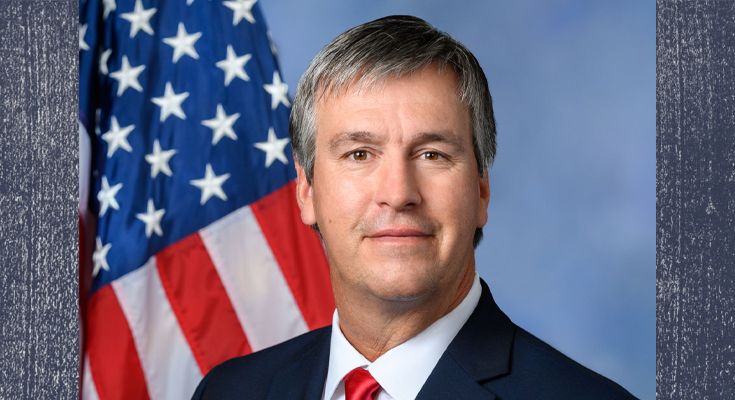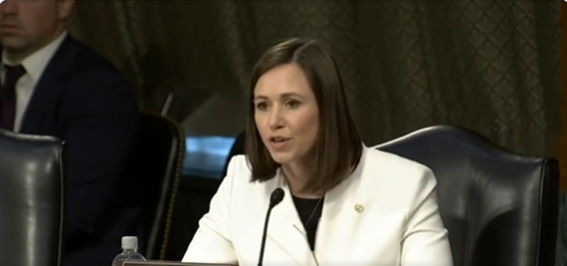
On Tuesday, U.S. Senator Katie Britt questioned federal bank regulators about what went wrong ahead of the failures of California-based Silicon Valley Bank and New York-based Signature Bank. “You need to be held accountable, every one of you,” Sen. Britt told the federal bank regulators.
Britt’s comments were made during a Senate Committee on Banking, Housing, and Urban Development hearing. Britt questioned federal financial regulators regarding their roles in the recent failures of Silicon Valley Bank and Signature Bank. Testifying witnesses were Martin Gruenberg, chairman of the Federal Deposit Insurance Corporation; Michael Barr, vice chairman for Supervision of the Federal Reserve System’s Board of Governors; and Nellie Liang, undersecretary for Domestic Finance of the U.S. Department of the Treasury.
“I appreciate the opportunity to be able to ask you all a few questions. I want to start by saying I am proud to be from the great state of Alabama where our financial institutions are strong — our regional banks, our community banks, our credit unions,” Britt said during her opening remarks. “The critical role they play from our main streets to our rural roads could not be overstated. So I am proud of the work they do and proud of the strength they continue to exhibit.”
Federal financial regulators admitted today that they don’t know if they used their existing toolbox correctly. But they’re asking for a bigger toolbox anyways.
— Senator Katie Boyd Britt (@SenKatieBritt) March 28, 2023
That’s what people hate about Washington.https://t.co/U254xa0nN7 pic.twitter.com/tSb6eX9XkA
“Mr. Barr, I wanna follow up on a question that one of my colleagues brought up,” Britt said. “You keep talking about the Fed focusing on the size of SVB and banks. However, 2155 also requires the Fed to take into consideration riskiness, complexity, financial activities, along with other risk-related factors. Tailored supervision ensures that the Fed focuses on the most risky banks. You’ve said repeatedly that bank mismanagement led to SVB’s failure. The whole point of 2155 was so that you could tailor your regs and your supervision to risk. So why did you not require definitive corrective action based on the flaws that you saw?”
“We are looking at the range of tailoring approaches the Federal Reserve took,” FDIC Chairman Barr said. “The decision to set those lines by asset size and other risk factors was made back in 2019. You know, I joined the board in July of 2022 and began looking at that approach. Uh, I expect to continue to review it as part of the SVB review. And I believe we have substantial discretion to alter that framework.
“So you’ve talked about your review, which is ongoing. In that review, will you take a look at if you used all of the tools in your toolbox to prevent this? Both before and after. Will that be part of your review?” Britt asked.
“Yes, Senator. The, the staff are reviewing the steps that supervisors took and whether they should have taken more aggressive action,” Barr answered.
“So, at current rate, though, you can’t speak to whether or not you utilized all of the powers that were given to you?” Britt asked.
“Uh, I, I really would like to wait for the formal review for the staff to come evaluate the full supervisory record to make an assessment,” Barr answered. “But we’re, we’re certainly very focused on that question. And if we didn’t do the right steps, we’re gonna say that.”
“Well, I find it concerning, though, when you all were asked, each one of you was asked, ‘Would you like to see more powers, more (regulatory) strength in this?'” Britt said. “Every single one of you said ‘yes’ when you don’t actually know if you utilized the tools in your toolbox correctly or if the people that were under your supervision were supervising appropriately. I think that’s what people hate about Washington. We have a crisis, and you come in here without knowing whether or not you did your job. You say you want more. That’s not the way this works. You need to be held accountable, each and every one of you. I’m a big believer you gotta own your own space.”
“Mr. Gruenberg, I wanna talk about yours,” Britt said. “So you were not the primary supervisor here. Obviously, that’s the Fed, but you are the non-primary supervisor for SVB, or were, is that correct?”
“Yes. We have backup supervision,” said Gruenberg.
“You have backup supervision. You had that before Dodd-Frank, correct?” Britt asked.
Gruenberg answered, “Yes.”
Britt asked: “You had it after Dodd-Frank, correct?”
Gruenberg answered, “Yes.”
Britt asked, “And 2155 did not change that responsibility that you had?”
Gruenberg said, “That’s correct.”
Britt said, “Right. So in that role, what did you do prior to the bank’s failure to exercise that power?”
“Yeah. In this, in this instance, we were working with the Fed as the institution was experiencing difficulties, but I think it’s fair to say that it was in a supportive role with the primary regulator,” Gruenberg answered.
Britt responded, “Okay. But you did raise this to the primary regulator? You did exercise that authority?”
Gruenberg stated, “We were working with the primary regulator in regard to the institution.”
“It seems that you failed to put the bank in receivership, and the FDIC passed on allowing the Silicon Valley Bank to be purchased,” Britt said. “Is that a correct assessment, or do you feel like that’s been incorrectly identified throughout the news cycles?”
‘Yes. Senator, the bank was placed in receivership on Friday morning,” Gruenfeld said. “And, um, we endeavored to solicit bids over the weekend, as I indicated previously, was that it was a rapid failure. So there was no opportunity prior to failure to prepare for a resolution. We tried to market it. We did two bids. Neither, neither would’ve been, um, less costly than liquidation. So we then proceeded to put in place a process where we were able to bid out these.”
A significant question that has haunted congressional investigators is: why didn’t federal regulators act decisively years ago when it was known that SVB was taking excessive risks and was increasingly reliant on a small pool of customers involved in highly speculative ventures.
“Six months prior, JP Morgan noticed that there was a problem their equity research team, and then Moody’s obviously met with SVB prior to saying that they were going to downgrade. So I’ve heard y’all say this was a rushed process. If the outside sector knew this was happening, you and the Fed and the 4,000 examiners should have known that this was coming as well.”
SVB’s failure and the cost of making all depositors whole will cost the FDIC $20 billion.
To connect with the author of this story or to comment, email brandonmreporter@gmail.com.
Related
Share via: