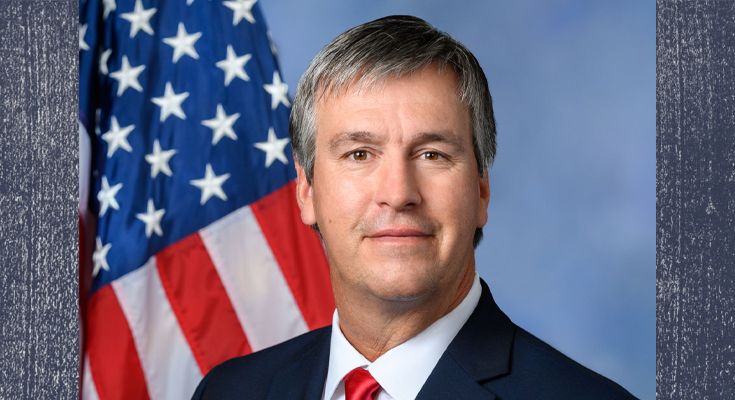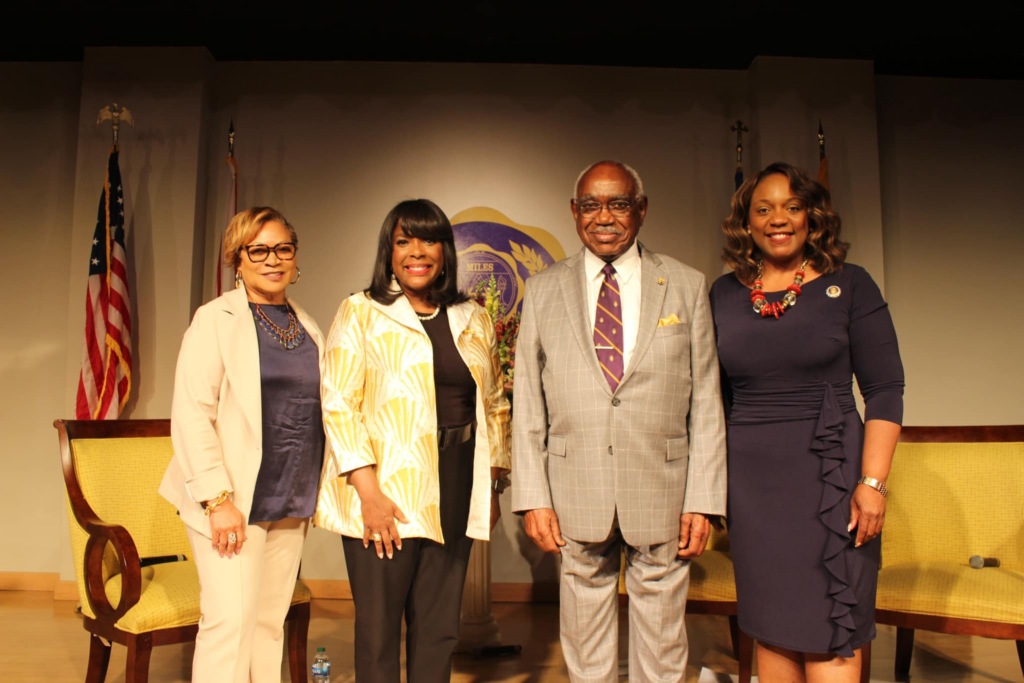
Congresswoman Terri Sewell (D-AL07) participated in a symposium on the Milligan v. Allen decision at Miles College on Tuesday. There Sewell said she would not be satisfied with less than “50 percent plus one or more” African American in two of Alabama’s congressional districts.
The Legislature redistricted the state in 2021, but the federal courts have since ruled that the Legislature’s redistricting violated the Voting Rights Act of 1965 and have ordered the Legislature to draw two majority-minority districts or at least two districts that were largely minority.
Sewell said that the recent Supreme Court decision affirming the three-judge panel of the Eleventh Circuit Court of Appeals decision was a surprise given previous court decisions by this current court.
“We all expected the Supreme Court to once again gut the Voting Rights Act,” Sewell said.
“I am so excited about the historic nature of our victory,” Sewell said. “It was a historic victory for not just Black Americans, but it was a victory for democracy.”
Sewell continued, “It is going to force the Alabama Legislature to draw a new congressional districting map by July 21. It (the ruling) does not say that we have to have two majority minorities districts.”
On Twitter, Sewell wrote, “The fight for voting rights is the fight of a lifetime. We’ve made progress, but if we are not vigilant about advancing it, we will lose it. Thank you @MilesCollege for hosting this critical and timely discussion! I was honored to join these distinguished guests!”
The fight for voting rights is the fight of a lifetime. We’ve made progress, but if we are not vigilant about advancing it, we will lose it.
— Rep. Terri A. Sewell (@RepTerriSewell) June 28, 2023
Thank you @MilesCollege for hosting this critical and timely discussion! I was honored to join these distinguished guests! ✊🏾 💜 pic.twitter.com/ldgFdFZsHg
Retired federal Judge U.W. Clemons said that he felt that the map adopted would be one that kept counties together as much as possible.
“I think the three-judge panel will give great deference to the map that respects the integrity of the counties,” Clemons said.
“I am looking for 50% (Black voters) plus more in each of the districts,” Sewell said.
“I am convinced that not only will this decision affect Alabama, it will affect the nation,” Clemons said. “The Supreme Court abided by the precedent set in Thornburgh versus Gingrich.”
Clemons explained that “three conditions” exist for creating a majority-minority district under the Thornburgh v. Gingrich precedent. “It has to have a large enough population of minority voters,” Clemons explained. “It has to be able to draw a cohesive district, and there has to be a history of the majority voting in a racially polarizing way. We meet all of those conditions here in Alabama.”
“Brown versus the Topeka Board of Education was first argued before the Supreme Court in 1952,” Clemons said.
Clemons explained that the ruling determined that separate but equal education was inherently unequal.
“That ruling was the first evidence during my life for that there was a God,” Clemons said, adding that this ruling also was likely due to God.
Clemons is retired from the federal bench, but he is not retired.
“This ruling has the potential to reshape this nation,” Clemons said.
Clemons said concerns about the public popularity of the current court may have motivated Chief Justice John Roberts to write this opinion in Milligan versus Allen.
“This court has the lowest credibility of any Supreme Court that has ever sat,” Clemons said. “The Chief Justice felt that he had to try to maintain at least some credibility with the public. It is a signal that he, as a chief justice, is representing the nation.”
“The Milligan case will have profound impact across this nation,” Sewell said.
State Senator Merika Coleman (D-Birmingham) said. “It truly is profound what has happened with the Milligan case.”
Coleman continued, “Of course, there will be some people who will try to do something that is not what the court said. A Senator I will not name here told me on the phone: We are just going to give you two districts that are 47% African American.”
Coleman said that the maps that the Legislature draws will still have to be shown to Milligan and the other plaintiffs in the case, and they can either accept them or ask that the three-judge panel appoint a special master to draw the districts.
“If they draw two districts that are 47% African American, a special master will have to come in,” Coleman said. “We want to be able to draw those districts ourselves.”
“We already have a safe African American congressional district,” Coleman said.
Coleman said that both districts need to be “50 percent plus one or more Black voting age population.”
“We have a real opportunity to pick our candidate of choice,” Coleman said.
“I have absolutely no faith that the Alabama Legislature is going to do the right thing. It never has,” Clemons said. “The courts are going to do it.”
“Neither Democrats or Republicans want the special master to come in,” Coleman said. “Congressional District Two is the one where my former colleague Barry Moore is.”
“The Legislature is going to do what it usually does,” Clemons said, “In 1872, we had one Black member of Congress. In 1874, we had one member of Congress.”
Alabama would not have another Black member of Congress until Earl Hilliard in 1992. Hilliard’s Seventh Congressional District was 65% African American. Today the Seventh Congressional District is represented by Sewell.
“It was 61% African American before redistricting,” Sewell explained. “It dropped to 55% in this redistricting. “It would not be fair for it to fall to below 50%.”
Clemons said that it is important that Blacks are united politically.
“If the Black Community had four political parties and all four were equal in strength, we would not be politically cohesive,” Clemons said. “For better or worse, most Black communities are Democrats. Frankly, our being Democrats means that we are politically cohesive.”
Sewell said that, “Change comes when ordinary people fight to do better, and they work on the ground.”
Sewell predicted that if the Democrats pick up a new majority-minority seat in Alabama, Louisiana, Arkansas, Georgia, Florida, and South Carolina, “the first African-American man Hakeem Jeffries will become the Speaker of the House.”
The Governor has called a special session for redistricting to start on July 17.
To connect with the author of this story or to comment, email brandonmreporter@gmail.com.
Related
Share via: