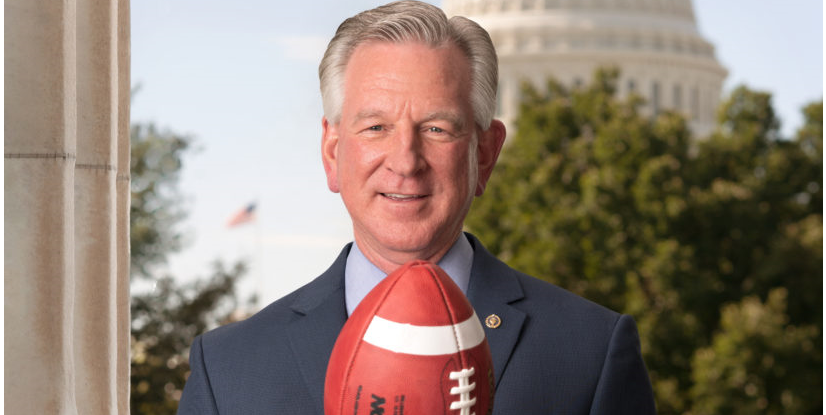
On Tuesday, U.S. Senators Tommy Tuberville (R-Alabama) and Joe Manchin (D-West Virginia) introduced the Protecting Athletes, Schools, and Sports (PASS) Act of 2023 to reform name image and likeness (NIL) standards in college sports. The sponsors say that their legislation protects student-athletes, maintains fair competition and compensation, strengthens transparency, and preserves the time-honored tradition of college sports.
“Student-athletes should be able to take advantage of NIL promotional activities without impacting their ability to play collegiate sports,” Sen. Tuberville said. “But we need to ensure the integrity of our higher education system, remain focused on education, and keep the playing field level. Our legislation with Senator Manchin will set basic rules nationwide, protect our student-athletes, and keep NIL activities from ending college sports as we know it.”
“As a former college athlete, I know how important sports are to gaining valuable life skills and opening doors of opportunity,” Sen. Manchin said. “However, in recent years, we have faced a rapidly evolving NIL landscape without guidelines to navigate it, which jeopardizes the health of the players and the educational mission of colleges and universities. Our bipartisan legislation strikes a balance between protecting the rights of student-athletes and maintaining the integrity of college sports. I urge my colleagues on both sides of the aisle to consider this commonsense legislation as a way to level the playing field in college athletics.”
I urge my colleagues on both sides of the aisle to consider my bipartisan Protecting Athletes, Schools, and Sports (PASS) Act of 2023 — commonsense legislation to level the playing field in college athletics. https://t.co/fUJkD0qHSS
— Senator Joe Manchin (@Sen_JoeManchin) July 25, 2023
The sponsors claim that two years after the U.S. Supreme Court decided National Collegiate Athletics Association v. Alston (Alston), this bipartisan legislation would finally create a national standard for Name, Image, and Likeness (NIL). This bill marks the culmination of a year-long initiative in which the Senators actively engaged with stakeholders to create these commonsense guidelines for the NIL system.
Specifically, the PASS Act would protect student-athletes by requiring collectives and boosters to be affiliated with a college or school. It would also encourage establishing a national standard for NIL. The PASS Act would preserve Title IX and ensure that nothing in the PASS Act affects the rights of any student-athletes or any programs funded through Title IX.
Sponsors say that it also protects higher education institutions by ensuring that schools, conferences, and associations are not liable for their efforts to comply with the PASS Act; and by prohibiting NIL agreements that involve alcohol, drugs, or conflict with existing school and conference licenses. It also requires student-athletes to ask permission to make use of existing intellectual property (IP).
Sponsors say that the PASS Act would preserve the future of college sports by prohibiting inducements. They also claim that it also improves the transparency of NIL activities by requiring agents and collectives to register with a regulating body and establishes a public-facing website to publish anonymized NIL data, and enquires all NIL contracts to be disclosed within 30 days.
The PASS Act moderate the Transfer Portal by requiring student-athletes to complete their first three years of academic eligibility before allowing them to transfer without penalty, subject to a few exceptions.
Tuberville and Manchin say that it ensures the health and safety of student-athletes by guaranteeing health insurance for sports-related injuries for uninsured student-athletes for eight years following graduation from a 4-year institution. The PASS Act would also require institutions generating more than $20 million and $50 million in athletics revenue to pay out-of-pocket expenses for two and four years, respectively. It also requires institutions to honor the original scholarship commitment made to a student-athlete and implements a Uniform Standard Contract for student-athlete use for NIL deals.
Sponsors say the bill will also enhance the curriculum on financial literacy, NIL rights, and related legal and regulatory issues while strengthening enforcement and oversight by directing the NCAA to oversee and investigate NIL activities and report violations to the Federal Trade Commission.
In June 2021, the NCAA Division I Board of Directors announced an “interim” policy suspending its rules relating to NIL compensation until federal legislation is enacted or until the NCAA adopts new rules. Following this announcement, there has been a push for Congress to act swiftly to provide clarity on NIL compensation.
In 2022, Senators Manchin and Tuberville solicited feedback from athletic leaders, including university athletic directors, administrators, associations, collectives, and student-athlete groups, to build consensus around this bipartisan legislation.
“The NCAA is transforming how it serves student-athletes by mandating Division I schools offer enhanced health, wellness, and academic protections and is moving ahead to support student-athletes as they monetize their NIL rights, but there are some challenges facing college sports that only Congress can address,” said NCAA President Charlie Baker. “The NCAA is encouraged by the significant, student-athlete centric reforms included in the Protecting Athletes, Schools, and Sports Act of 2023 (“PASS Act”), introduced today in the United States Senate. This important legislation is a major step in the right direction to ensure the health and safety of student-athletes, includes key measures to increase consumer protections and transparency in the NIL market, and aims to protect women’s and Olympic sports. There is clearly growing bipartisan interest in taking legislative action to create a stable, sustainable, and equitable foundation for future generations of student-athletes, and we are committed to working with all stakeholders to get this done.”
“Auburn University appreciates the efforts undertaken by Senators Tommy Tuberville and Joe Manchin to create a national framework for NIL that establishes clear rules and addresses the patchwork of conflicting state laws governing collegiate athletics,” said Auburn University President Christopher B. Roberts. “We look forward to continuing to work with these offices, other members of the House and Senate, and the Southeastern Conference as this process continues.”
“We love and celebrate collegiate athletics, but the landscape has changed dramatically as schools and student-athletes are now forced to navigate a patchwork of inconsistent regulations regarding Name, Image, and Likeness,” said West Virginia University President Gordon Gee. “This is not sustainable. That is why I am so glad for Sen. Manchin’s leadership and encourage Congress to provide the necessary direction at the federal level to create a pathway for establishing a common set of ground rules related to NIL, as well setting guard rails around the transfer portal.”
“We are appreciative to the Senators for their leadership in developing national standards aimed at protecting student-athletes and preserving the integrity of, and opportunities provided by, intercollegiate athletics,” said University of Alabama President Stuart R. Bell. “We are grateful for their collaboration and remain optimistic about the efforts to produce effective national legislation.”
“The Southeastern Conference appreciates the efforts of Senator Tommy Tuberville and Senator Joe Manchin in their work to craft a bill that addresses the opportunity for college athletes to benefit from their name, image and likeness, and other issues important to the future of college sports,” said the SEC in a statement. “Senators Tuberville and Manchin have a keen understanding of the need for national standards to preserve the integrity of fair competition at all levels of intercollegiate athletics. We look forward to continuing to engage with members of the House and Senate to refine and work toward effective national legislation that creates and preserves opportunities for all college athletes.”
Limits on the use of the Transfer Portal will likely be met with the greatest resistance from player proponents. Coaches routinely leave programs at will when offered more money by other programs. Why would athletes not have the same flexibility to pursue dollars and a culture that they are more comfortable with?
Tuberville is a former College football head coach at Ole Miss, Auburn, Texas Tech, and Cincinnati.
To connect with the author of this story or to comment, email brandonmreporter@gmail.com
Related
Share via: