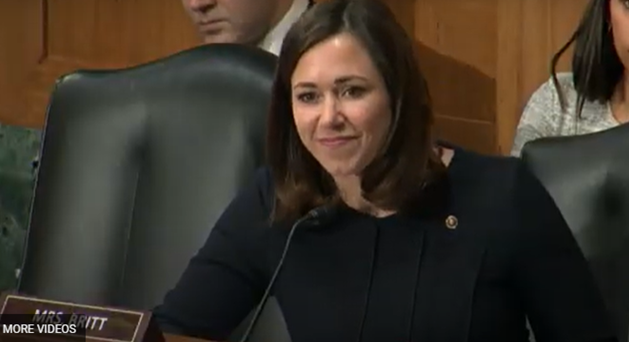
On Wednesday, U.S. Senator Katie Britt (R-Alabama) participated in a Banking, Housing, and Urban Affairs Committee hearing featuring testimony from the CEOs of the eight globally systemic banks (G-SIBs) in the United States. The witnesses were Charles Scharf of Wells Fargo, Brian Moynihan of Bank of America, Jamie Dimon of JPMorgan Chase, Jane Fraser of Citigroup, Ronald Hanley of State Street, Robin Vince of BNY Mellon, David Solomon of Goldman Sachs, and James Gorman of Morgan Stanley.
Britt asked Wells Fargo’s Scharf whether the Basel III Endgame proposed rule, recently issued jointly by three federal banking regulators, would affect lending at rural bank branches, especially given that over 42% of residents in Alabama live in rural areas.
“Well, Senator, we are going to be commenting to the Federal Reserve,” Scharf said.
“We do think there are a series of asset classes, when you look at the increases in capital that are proposed, [that] would affect both the availability of credit and the pricing of credit in the marketplace. And additionally, as we’ve seen in other asset classes when regulation like this has taken hold, you can see substantial migration outside of the regulated banking system.”
Britt asked Bank of America’s Moynihan, “Briefly explain this trickle-down effect, and if your banks are squeezed by the requirements of this rule, what does this ultimately mean for maybe small business owners seeking a loan, a first-time home buyer, or a small financial institution in, let’s say Alabama?”
Moynihan responded, “Thank you, Senator. As Mr. Scharf said, and we talked about a lot today, if you have the same capital requirements increase by 20 percent to do the exact same activities you did yesterday, you have to get a higher return, and that higher return will be borne by the customer base, or you’ll have to leave the business. And either one of those is not good for the customer base, and it applies across the board.”
“In fact, the idea that this doesn’t trickle down through the banking system. Overall, we provide services to a lot of those smaller banks, and those costs of those services will go up to them,” Moynihan added. “And, so, it has much more of an impact than people think.”
“Would it be an inaccurate statement for regulators to assume that under this threshold, those under the hundred-billion-dollar asset mark, they have said, you know, they won’t feel the impacts of this?” Britt asked. “So, my question for you is, will those institutions and people and things that I just mentioned under the hundred-billion-dollar [asset] mark, that are quote, “not affected by this,” will they feel the impacts of Basel III? Just if we can ‘yes’ or ‘no’ down the line.”
Scharf replied, “Ultimately, yes.”
Moynihan answered by nodding his head in affirmation.
Dimon answered, “Absolutely. You provide a lot of services.”
Fraser replied, “Yes. The trickle-down effect is real.”
Hanley said, “Yes. It’s an integrated system.”
Vince replied, “Yes, Senator, that’s likely.”
Solomon said, “Yes, I agree.”
Gorman answered, “Yes.”
Britt asked, “And last but not least, if this rule is implemented as written, do we risk putting the United States banking sector at a global competitive disadvantage? Mrs. Fraser, do you mind answering that?”
“Yes, we will,” answered Citigroup’s Fraser. “We already have an unlevel playing field with the European banks. The American banks play an incredibly important role globally in the financial system and ultimately affect the competitiveness of American companies. This is important.”
The Biden administration wants to raise the reserve capital requirements on large banks. Critics of this move are concerned that that will lead to fewer dollars available economy-wide to borrowers meaning higher interest rates and fewer American families and businesses having access to credit.
Vice Chair for Supervision of the Federal Reserve Michael Barr told the committee that he believed the proposed rule would have a “minimal impact on lending.”
Britt questions the need for the new proposal and worries about there being a trickle-down effect from this tightened regulation.
“Over the last year, we have seen a host of incredibly complex and market-altering rules come out of nearly every financial federal agency,” Britt said. “Interestingly, five of our top financial regulators sat before this very committee last month and unanimously told me that they believed the U.S. banking system to be strong, while at the same time, they argued for proposals that could fundamentally weaken it without providing any adequate answer to the question, ‘Why?’”
“At the end of the day, the G-SIBs play a vital role in the U.S. economy, and I don’t want to diminish that,” Britt said. “However, I do want to focus on downstream. So, impacts on, let’s say, Alabama’s smaller financial institutions, small businesses across the country, those in manufacturing and energy sectors, individuals seeking maybe a short-term liquidity, to help pay their bills. I think the list of these potentially impacted goes on and on and on and on. And on this point, your banks have said that by raising capital requirements by nearly 20 percent, the proposal would ultimately limit access to capital across the board and undermine economic growth.”
“The rule assumes that banks are significantly undercapitalized for operational risk but yet cites no evidence to support this assumption,” Britt said recently of the proposed rules change. “Not only are these risks already accounted for in stress testing, but the new standardized approach is not tailored to the varying business models of various banks.
Katie Britt was elected to the Senate in 2022.
To connect with the author of this story or to comment, email brandonmreporter@gmail.com.
Related
Share via: