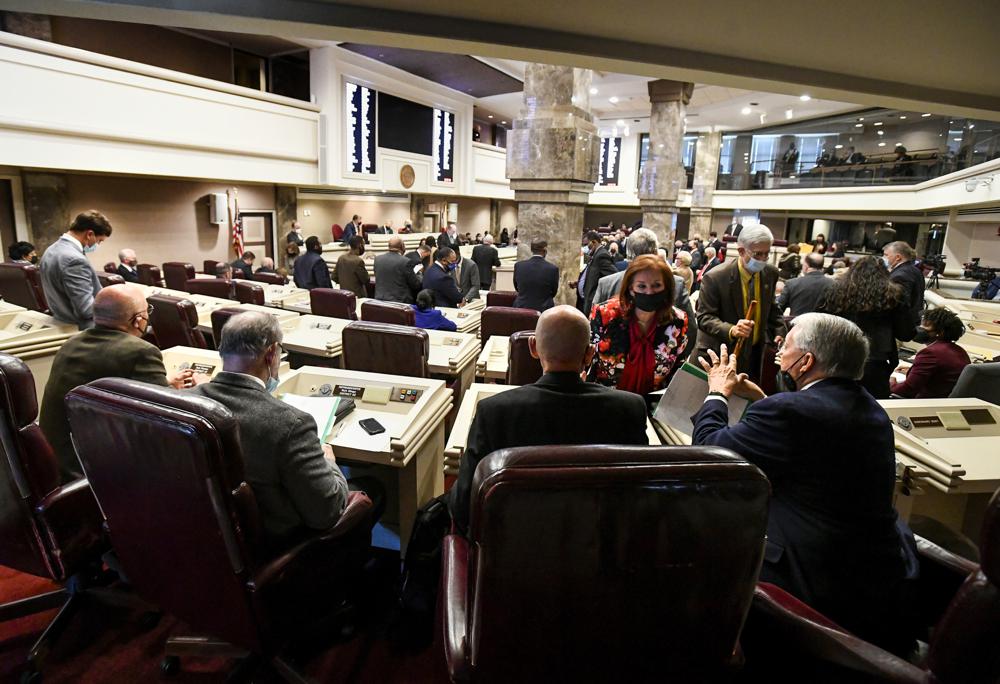
An Alabama legislative committee on Tuesday took seconds to advance a bill banning “divisive concepts” in classroom lessons and in state diversity training, including that white people should feel guilt over the actions of their ancestors.
African American members of the House State Government Committee objected to the voice vote, which took place within 20 seconds of the bill being brought for discussion and without opposed lawmakers getting an opportunity to speak. The bill now moves to the full House of Representatives.
“I think it is unjust,” Rep. Rolanda Hollis, a Democrat from Birmingham, said after the meeting of the quick approval. Hollis said she wanted to offer an amendment to the measure, adding, “This bill right here, it stops us from being able to teach history, real history.”
The bill by Republican Rep. Ed Oliver of Dadeville would prohibit a list of “divisive concepts” from being taught in schools and in diversity training for state entities. The banned concepts would include that the United States is “inherently racist or sexist” and that anyone should be asked to accept “a sense of guilt, complicity, or a need to work harder solely on the basis of his or her race or sex.”
It would also prohibit “fault, blame, or bias” from being assigned to a race, sex, or religion, or to members of a race, sex, or religion, solely on the basis of their race, sex, or religion.
“I don’t think you should be teaching children because of their skin color that they are necessarily bad, or they can’t succeed because of their skin color,” Committee Chairman Chris Pringle, a Republican from Mobile, said of why he planned to vote for the bill on the House floor.
The legislation comes as Republicans in several states seek to ban either so-called critical race theory or put guidelines on how race is discussed in the classroom.
Republican supporters have said it would steer classroom lessons to facts, rather than ideology, and prevent educators and diversity trainers from stoking divisions. While opponents said it is motivated by election-year politics and would have a chilling effect on classroom lessons and discussions in an effort to “whitewash” history.
The list in the Senate bill is similar to a 2020 executive order President Donald Trump issued banning “divisive concepts” in training federal employees that has since been repealed. Similar language has since popped up in bills in dozens of states.
The bill would prevent a public K-12 school or state agency from teaching one of the “divisive concepts” to students, employees, and contractors. A college could “teach about doctrines pertaining to a divisive concept” as part of a larger course of instruction but could not compel “students to assent to the concept.”
Rep. Kelvin Lawrence, a Democrat from Hayneville, said the bill is vaguely worded and he is concerned it will make professors fearful of delving into certain topics.
“They’re just going to avoid teaching those things, and unfortunately, that’s a critical part of our history, a critical part of what has happened in America and what continues to happen,” Lawrence said.
Democratic Rep. Chris England, who is chairman of the Alabama Democratic Party, criticized the way the committee handled the bill. He tweeted that Republicans on the committee silenced the opposition to “pass a bill that will prohibit free speech and whitewash history.”
Pringle defended the swift approval, noting the bill had been discussed at two previous meetings, including one with a public hearing. “What more is there to say that we haven’t heard in the public hearing or the debate we had last week,” Pringle said.
The committee had previously deleted language in the original version that dealt with how slavery should be taught.
A similar bill is pending in the Alabama Senate.
Republished with the permission of the Associated Press.
Related
Share via: